

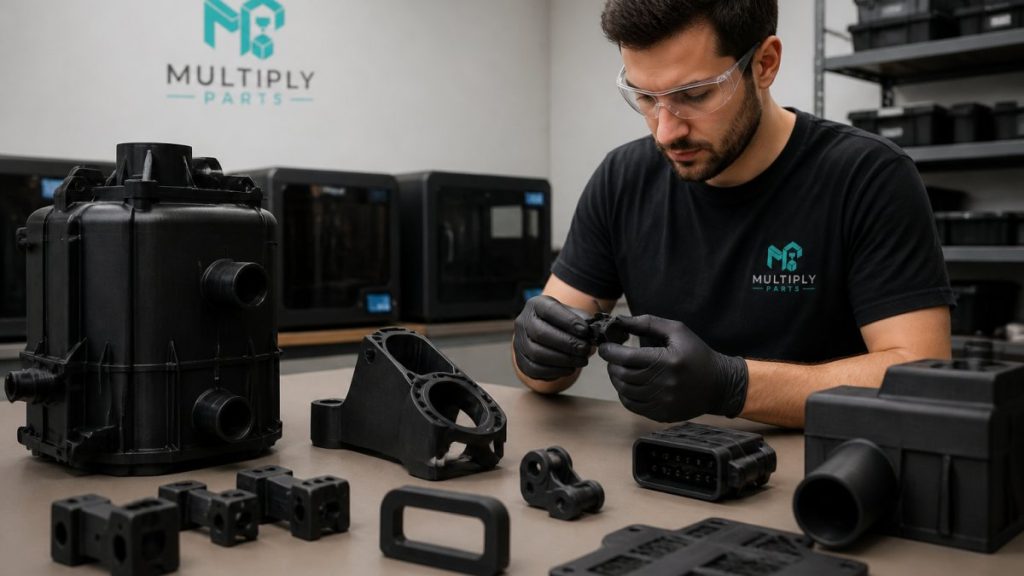
Efficient Manufacturing Infrastructure for EV Parts
Table of Contents
- What Efficient EV Parts Manufacturing Infrastructure Looks Like
- Key Features to Compare in EV Parts Manufacturing Equipment
- Supplier Comparison: Infrastructure for EV Component Production
- 3D Printing vs Injection Molding Cost: Which Infrastructure Fits Your Volume?
- Rapid Prototyping for Electric Vehicles: Infrastructure That Keeps Pace
- Manufacturing Quality Control: Standards and Traceability for EV Parts
- Total Cost of Ownership: Investment Requirements and Factory-Level Efficiency
- Verdict: Building a Scalable EV Parts Manufacturing Operation
- Frequently Asked Questions
Last Updated: October 9, 2026
What Efficient EV Parts Manufacturing Infrastructure Looks Like
EV parts manufacturing is the production of components built specifically for electric drivetrains: motor housings, battery enclosures, brackets, busbars, and structural parts that carry load or manage heat.
Natural Resources Canada’s electric vehicle technology research tracks how quickly EV platforms evolve, and that pace drives the real constraint: infrastructure has to keep pace with design changes, not just with volume.
The Four Pillars of Professional-Grade Infrastructure
Four capabilities separate a workshop that can make one good prototype from one that can make five hundred identical ones:
- Dimensional accuracy – consistent tolerances across a full production run, not just the first part
- Material range – high-performance materials matched to heat, load, and impact requirements
- Production line integration – subassembly lines, material handling, and just-in-time scheduling that connect to your assembly operations
Miss any one and the whole system stalls. A shop with tight tolerances but no traceability cannot serve an automotive supply chain. A shop with great materials but no line integration cannot scale.
Efficiency in EV component manufacturing comes from process fit, not machine size. Match the process to the part and the volume, then build the quality system around it.

Key Features to Compare in EV Parts Manufacturing Equipment
Start with the process, not the brochure.
Automation and production line integration matter most when volume climbs. A subassembly line with automated material handling reduces manual touchpoints, which is where most variability enters a manufacturing process.
Ask suppliers these questions before committing:
- What tolerance can you hold across a full run, not just a sample?
- How does your process handle a design revision mid-run?
- What does your quality control documentation look like per part?
That last point is where most EV startups get caught. The process that made a perfect prototype often cannot hold tolerance at volume, and switching processes mid-project means re-qualifying everything.
Supplier Comparison: Infrastructure for EV Component Production
Most supplier comparisons stop at a feature table. That is not a decision. A professional-grade evaluation compares infrastructure categories against the stage of your program, the tolerance your part actually needs, and the risk you can carry if a supplier slips.
The framework below separates infrastructure by what it is built to do, not by marketing claims. Use it to shortlist, then qualify with the audit criteria that follow.
| Infrastructure Category | Best For | Standout Capability | Main Limitation |
|---|---|---|---|
| Additive and short-run production | Prototyping through bridge production, EV brackets, housings, and accessories | No tooling barrier, fast design iteration, no minimum order quantities | Not cost-competitive against stamping or molding at stable high volume |
| High-volume metal forming and stamping | Structural parts, brackets, and enclosures at OEM volumes | Low cost per part once tooling is amortized, high throughput | Long tooling lead times, expensive design changes, high minimums |
| Precision machining and forging | Motor shafts, gears, and load-bearing drivetrain parts | Tight tolerances, strong material properties, repeatable surface finish | Slower cycle times, higher per-part cost at low volume |
| Battery and power electronics integration | Pack assembly, busbars, thermal management, inverters | Cell-to-pack capability, high-voltage safety processes | Capital-intensive, long qualification cycles, global demand pressure |
| Test and validation infrastructure | Quality assurance, R&D, and incoming inspection | Battery, inverter, and power electronics test coverage | High cost of entry, requires trained operators |
Build Versus Buy: A Qualification Framework
Before comparing suppliers, decide whether the work belongs in-house at all. In-house production makes sense when the part is core to your IP, volumes are stable enough to amortize equipment, and you can staff the quality function. Contract manufacturing makes sense when volumes are uncertain, the design is still moving, or the process is outside your competence. Capital allocation strategies often dictate these decisions, as securing manufacturing equipment financing remains a critical factor in balancing long-term asset ownership against the flexibility of outsourced production.
A practical supplier qualification sequence:
- Capability screen – confirm the process can hold your tolerance across a full run, not just a sample.
- Capacity check – ask for current utilization and lead time at your target volume, not at your prototype volume.
- Quality system review – request the scope of their quality management certification and the last internal audit summary.
- First article inspection – send the same part file to two or three suppliers and compare the first article, not the quote.
- Traceability test – ask them to show how they would identify which material batch a finished part came from.
- Change-control review – confirm how a mid-run design revision is handled, priced, and documented.
Risk Factors to Price In
Supplier risk is not just price. Lead-time variability, single-source dependency, geographic concentration, and tooling ownership all affect total program cost. A supplier that is 15 percent cheaper per part but adds three weeks of variability to every revision is usually the more expensive choice over a product’s life.
When you evaluate a supplier, send the same part file to two or three of them and compare the first article, not the quote. The quote tells you price; the first article tells you whether they can hold tolerance.

3D Printing vs Injection Molding Cost: Which Infrastructure Fits Your Volume?
The 3D printing vs injection molding cost question has a simple shape: 3D printing costs more per part but carries almost no upfront tooling, while injection molding costs less per part but requires a mold investment before the first unit exists. At low volume, printing wins on total spend. At high volume, molding wins on unit economics.
Break-Even Points and When to Switch
Break-even is not a fixed number. It depends on part size, material, mold complexity, and how many design iterations you expect. A practical way to think about it:
- Prototypes and design validation – 3D printing, every time. No tooling means you can revise and reprint without writing off a mold.
- Bridge production – 3D printing still wins if your design is still changing or your volumes are modest.
- Stable design, high volume – injection molding becomes the cost-efficient path once the design is frozen and volumes justify tooling.
The mistake we see most often is ordering tooling before the design is actually frozen. A mold cut for a design that changes two months later is money spent twice.
Committing to injection molding tooling before your design is validated is the single most expensive mistake in EV part production. Revisions after tooling mean either a costly mold modification or a scrapped mold.
Rapid Prototyping for Electric Vehicles: Infrastructure That Keeps Pace
Rapid prototyping for electric vehicles works when the infrastructure supports fast iteration: upload a file, get a quote, receive a part, revise, repeat. The bottleneck is rarely the printer.
Instant pricing removes the wait between “I have a design” and “I know what it costs.” No minimum order quantities means a single revised bracket does not require a production commitment.
For EV accessory brands, that loop is the whole game. HitchStyle.com, a customer of ours, needed custom parts for vehicle accessories where fit and finish matter and volumes start small.
Manufacturing Quality Control: Standards and Traceability for EV Parts
Quality control for EV parts rests on three things: a documented process, measurable acceptance criteria, and traceability from material batch to finished component. Without all three, you cannot prove a part meets specification, and in an automotive supply chain, unproven is the same as failed.
For Canadian manufacturers, the relevant framework is ISO 9001 for quality management systems, and automotive suppliers often work toward IATF 16949 requirements. ISO 9001 quality management standards sets out the general framework; Transport Canada’s motor vehicle safety regulations govern the safety requirements finished vehicle components must meet.
Traceability is what separates a supplier from a vendor. Ask for material certificates, inspection records, and a clear path to identify which batch a part came from if a field issue appears.
Total Cost of Ownership: Investment Requirements and Factory-Level Efficiency
Total cost of ownership for EV parts manufacturing infrastructure includes far more than the machine price. Tooling, floor space, labor, material waste, changeover time, energy, and quality rework all land in the same column. The only way to compare options honestly is to convert each into a cost per good part and a factory-level efficiency metric.
Factory-Level Efficiency Metrics to Track
These are the KPIs most practitioners use to judge whether infrastructure is earning its keep:
- Overall equipment effectiveness (OEE) – availability multiplied by performance multiplied by quality. It captures downtime, speed loss, and defects in one number.
- Cycle time – time to produce one part at a defined process step.
- First-pass yield – share of parts that meet specification without rework.
A process can look efficient on paper and still lose money if changeover time is long, first-pass yield is low, or energy use per part is high. Track the metrics together, not in isolation.
Cost Categories That Drive the Comparison
- Capital cost – equipment, installation, tooling, and facility changes. This is the visible number.
- Operating cost – labor, material, energy, and maintenance per part. This is where most of the lifetime spend sits.
- Flexibility cost – how much a design change costs in time, tooling, and re-qualification.
A Simple Comparison Method
To compare two infrastructure options, estimate the following for each:
- Annual volume of good parts required.
- Cost per good part, including material, labor, energy, and rework.
- Annual fixed cost, including equipment amortization, tooling, and floor space.
- Expected number of design changes per year and the cost of each.
- Ramp-up time from design freeze to stable production.
Infrastructure that is cheap to buy but rigid on design changes often costs more over a product’s life than infrastructure that costs more upfront and adapts. For EV work, where platforms and form factors keep moving, flexibility carries real value that shows up in the changeover and flexibility cost lines, not in the purchase price.
Compare infrastructure on cost per good part and factory-level KPIs, not on sticker price. Flexibility, yield, and changeover time are cost drivers, not soft benefits.
Verdict: Building a Scalable EV Parts Manufacturing Operation
The scalable operation is the one that matches process to stage. Prototype with a process that has no tooling barrier. Validate quality with documented control and traceability.
That staged approach is exactly what we built MultiplyParts around. Fast turnaround and many high-performance materials keep prototyping and short-run production in one place, so you are not re-qualifying a new supplier every time your volume changes.
Frequently Asked Questions
What manufacturing processes are used to make electric vehicle parts?
EV parts manufacturing uses a mix of processes depending on the component. Precision machining and forging shape metal drivetrain parts like gears and shafts. Injection molding produces high-volume plastic housings and connectors. 3D printing handles rapid prototyping for electric vehicles and short-run production of custom brackets, enclosures, and ducting. Battery systems and power electronics often require specialized assembly lines with strict quality control. The right mix depends on your volume, material requirements, and how often designs change.
Is 3D printing or injection molding more cost-effective for EV parts?
It depends on volume and design stability. Injection molding carries high upfront tooling costs but delivers very low per-part costs at scale, making it ideal for thousands of identical units. 3D printing requires no tooling, so it wins for prototypes, small batches, and parts that may still change. For many EV accessory makers, the smart path is 3D printing for validation and bridge production, then injection molding once the design is frozen and volumes justify the tooling investment.
How do manufacturers scale EV parts from prototypes to production?
Scaling starts with a design that has been validated through rapid prototyping for electric vehicles. From there, you select a production method that matches your target volume, such as 3D printing for bridge production or injection molding for high-volume runs. Quality control systems must scale alongside output, with documented inspection points at each stage. Working with a supplier that offers no minimum order quantities lets you increase batch sizes gradually rather than committing to a large run before the design is proven.
What should businesses consider when choosing an EV parts supplier?
Focus on four things: production capacity and scalability, material range, quality control processes, and total cost of ownership. Ask whether the supplier can grow with you from 50 units to 500 or more per month without quality drift. Confirm they offer traceability and compliance documentation. Check lead times and how they handle design revisions. A supplier with instant pricing and no minimums reduces your financial risk during early production stages.
Scaling EV part production without overcommitting to tooling is the hard part, and it is where most small teams stall. MultiplyParts handles it with no minimum order quantities, instant pricing, and fast turnaround on high-performance materials for EV and sports parts. Get an Instant Quote and see what your design costs to produce before you commit to anything.
