

5 Best Industrial 3D Printing Materials for EV Parts
Table of Contents
- Top Industrial 3D Printing Materials for EV Parts Compared
- 1. PEEK: The Best Industrial 3D Printing Material for Extreme Heat
- 2. Carbon Fiber Reinforced Nylon for EV Parts: Stiffness Without the Weight
- 3. Ultem (PEI): Flame Retardant 3D Printing Material for EVs
- 4. Polycarbonate: A Durable Automotive Grade 3D Printing Material
- 5. TPU: Flexible Thermoplastic Polyurethane for Seals and Damping
- How to Choose the Right Material for Your EV Part
- Why Weight Reduction Matters for EV Range
- What About Sustainability and End-of-Life?
- Frequently Asked Questions
Last Updated: September 30, 2026
Top Industrial 3D Printing Materials for EV Parts Compared
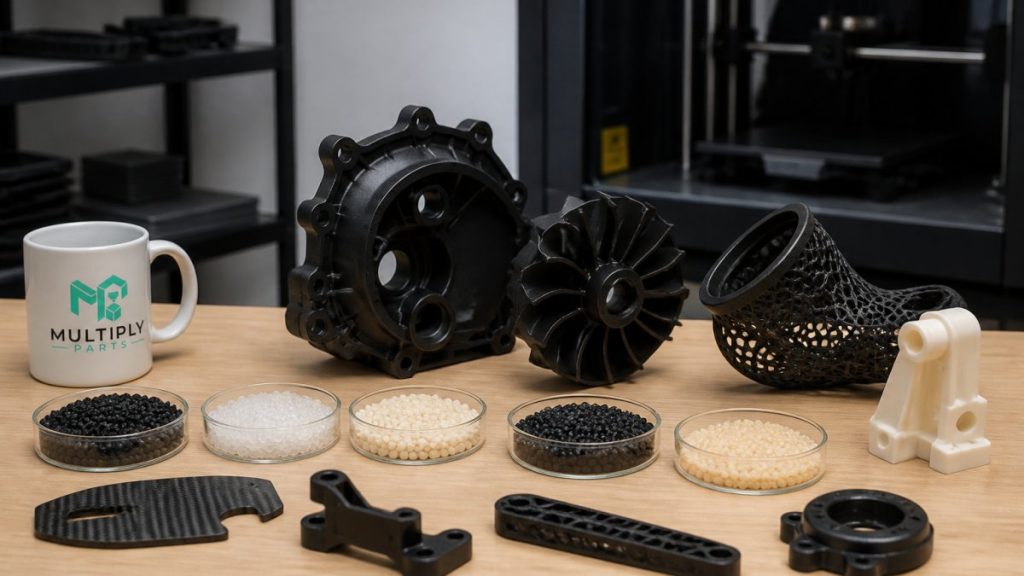
The best industrial 3D printing materials for EV parts must survive under-hood heat, battery chemistry, and vibration while staying light enough to protect range. MultiplyParts compares five.
| Material | Heat Resistance | Key Strength | Best EV Application |
|---|---|---|---|
| PEEK | Up to 250°C | Chemical and thermal stability | Under-hood structural parts |
| Carbon Fiber Nylon | Moderate | Stiffness-to-weight ratio | Brackets and chassis components |
| Ultem (PEI) | High, long-term | Dielectric strength | Battery housings and connectors |
| Polycarbonate | Moderate | Impact strength | Interior trim and prototypes |
| TPU | Low | Elasticity and damping | Gaskets, seals, mounts |
1. PEEK: The Best Industrial 3D Printing Material for Extreme Heat
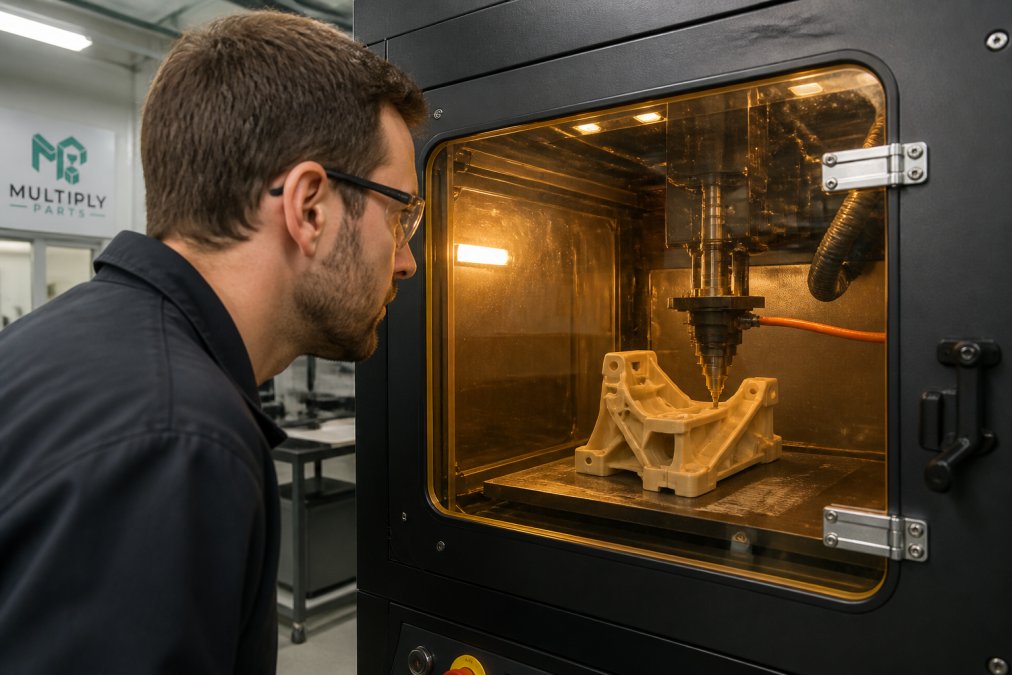
PEEK holds its mechanical properties up to 250°C and resists brake fluid, coolant, and battery electrolytes, making it the top choice near motors, inverters, and battery packs. It needs a heated-chamber printer and costs the most here.
PEEK parts often need annealing after printing to reach full crystallinity. Skipping this step leaves the part weaker than its datasheet suggests, a mistake that only shows up under vibration testing.
2. Carbon Fiber Reinforced Nylon for EV Parts: Stiffness Without the Weight
Carbon fiber reinforced nylon (PA-CF) pairs nylon’s toughness with carbon fiber’s rigidity, making it the best stiffness-to-weight balance for brackets, chassis components, and rigid housings. The abrasive fibers require hardened steel or ruby tooling.
3. Ultem (PEI): Flame Retardant 3D Printing Material for EVs
Ultem offers high dielectric strength, long-term heat resistance, and inherent flame, smoke, and toxicity compliance, the go-to for battery housings and electrical connectors. It demands a heated chamber, high nozzle temperatures, and good layer adhesion.
4. Polycarbonate: A Durable Automotive Grade 3D Printing Material
Polycarbonate is a strong, transparent, heat-resistant thermoplastic that’s a cheaper alternative to PEEK for interior components and light-duty prototypes. It warps as it cools, a heated chamber and bed adhesive solve most of it.
Printing large polycarbonate parts on an open-frame printer almost always ends in warped, unusable components. If dimensional accuracy matters, use an enclosed machine or a service that has one.
5. TPU: Flexible Thermoplastic Polyurethane for Seals and Damping
TPU’s elasticity and abrasion resistance make it ideal for EV gaskets, seals, and vibration-dampening mounts that absorb road noise and motor vibration. Flexible filament buckles in a Bowden setup, so a direct-drive extruder is essential.
How to Choose the Right Material for Your EV Part
Choosing comes down to three questions: how hot does the part get, how much load does it carry, and does it touch battery chemistry or live electrical components?
- Above 150°C or exposed to fluids: PEEK
- Load-bearing and weight-sensitive: Carbon fiber reinforced nylon
- Battery housing or electrical insulation: Ultem (PEI)
- Interior or prototype parts on a budget: Polycarbonate
- Seals, gaskets, or vibration mounts: TPU
For teams moving from prototyping to end-use parts, the material often changes between stages, plan that transition early to avoid re-qualifying a part twice.
Why Weight Reduction Matters for EV Range
Every kilogram removed pays off in range, which is why lightweighting sits at the center of EV design. Carbon fiber reinforced nylon and PEEK deliver the strength-to-weight ratio to replace metal brackets with reinforced polymer equivalents, but only if durability testing confirms the lighter part handles real-world loads.
What About Sustainability and End-of-Life?
Thermoplastics like PEEK, Ultem, and nylon can be reground and reused in some applications, supporting circularity goals. Designing for disassembly and material recovery is a smaller factor than heat resistance or strength today, but growing.
Frequently Asked Questions
Which 3D printing materials are best for high-heat EV components?
PEEK and Ultem (PEI) handle the highest temperatures. PEEK resists heat up to 250 degrees C and stands up to automotive fluids, making it suitable for under-the-hood parts. Ultem offers long-term heat resistance and inherent flame, smoke, and toxicity compliance, which matters for battery housing components. For less extreme conditions, polycarbonate provides good heat resistance at a lower cost. Match the material’s heat deflection temperature to your part’s actual operating environment before committing to production.
Are 3D printed parts durable enough for electric vehicle use?
Yes, when the right material and process are matched to the application. Carbon fiber reinforced nylon delivers high tensile strength and impact resistance for brackets and chassis components. PEEK provides superior durability in harsh conditions. The key variables are layer adhesion, print orientation, and post-processing. Parts loaded along the layer lines behave differently than isotropic molded parts, so design for the anisotropic strength profile of 3D printing rather than assuming molded-part performance.
What are the regulatory considerations for 3D printed automotive parts?
Automotive parts sold in Canada must meet applicable Transport Canada safety standards, and materials used in EV battery enclosures need flame retardancy and thermal stability documentation. Ultem carries inherent flame, smoke, and toxicity compliance, which simplifies validation. For any end-use part, request material datasheets and durability testing records from your manufacturing partner before production. Compliance requirements vary by component and vehicle class, so confirm the specific standard that applies to your part.
Matching the right polymer to each EV component is where most projects stall. MultiplyParts removes that friction with instant pricing, no minimum order quantities, and a material range built for the sports and electric vehicle markets. Upload your CAD files, get a quote in minutes, and move from prototype to production with a Canadian manufacturing partner that understands EV requirements. Get an Instant Quote and put the right material to work on your next part.
