

How to Choose 3D Printing Materials for Strength
Table of Contents
- Step 1: Map the Loads Your Part Will Actually Carry
- Step 2: Run a 3D Printing Material Strength Comparison
- Step 3: PETG vs PLA+ Strength and Other Common Filament Matchups
- Step 4: Account for 3D Print Strength and Layer Orientation
- Step 5: Match the Best 3D Printing Material for Load-Bearing Parts to Your Environment
- Step 6: Know the Limits of Reinforced Filaments and Datasheet Values
- Step 7: Validate the Design Before You Commit to Production
- Frequently Asked Questions
Last Updated: October 6, 2026
Step 1: Map the Loads Your Part Will Actually Carry
Choosing 3D printing materials for strength starts with the loads your part will face, not the material label. A bracket that holds a static shelf needs very different properties than a latch that snaps shut a thousand times.
Static loads stay constant. A mount, a spacer, or a housing mostly sits there. Dynamic loads cycle, bend, or strike, and they punish brittleness fast.
Ask three questions before anything else:
- Where does the force hit, and in which direction?
- Does the part flex, snap, or just hold?
- Will it face heat, sun, or moisture?
Get these answers first. They shrink your shortlist to two or three real options.
Step 2: Run a 3D Printing Material Strength Comparison
A useful 3D printing material strength comparison weighs four properties: tensile strength, stiffness, impact resistance, and heat deflection. No single filament wins all four.
Here is how the common options stack up on the traits that matter for load-bearing work.
| Material | Tensile Strength (MPa) | Stiffness / Modulus | Impact Resistance | Heat Deflection |
|---|---|---|---|---|
| PLA | 45-60 | High | Low | Low (~55 °C) |
| PETG | 45-55 | Medium | High | Medium (~70 °C) |
| ABS | 35-45 | Medium | Medium | Medium-High (~95 °C) |
| Nylon (PA) | 60-80 | Medium | Very High | Medium (~90 °C) |
| Polycarbonate | 55-70 | High | High | High (~130 °C) |
The technical definitions behind those columns follow the same logic used in material testing for plastics. Tensile strength measures how much pull a material takes before it breaks.
Reading the trade-offs, not just the numbers
- PLA posts the best stiffness-to-cost ratio of any common filament, but its low impact strength and low heat deflection make it a poor fit for anything that gets knocked or left in a warm car.
- PETG trades some stiffness for toughness. It bends noticeably before it breaks, which is why it survives repeated flexing better than PLA at similar tensile numbers.
- ABS sits in the middle on every axis. It is rarely the best choice for a single property, but it is a reasonable all-rounder when heat and impact both matter.
- Nylon has the highest impact resistance of the group and good tensile strength, but it absorbs moisture from the air, which softens it over time unless the part is dried and stored properly.
Why the same material can rank differently in two parts
A material’s position in this table assumes the load is applied along the layers. Flip the load direction and the ranking can change, because layer adhesion, not the raw polymer, becomes the limiting factor. That is why this table is a starting point, not a decision. The next sections cover orientation, environment, and reinforcement, all of which can move a material up or down the list for your specific part.
Pick the property your part actually needs most, then accept the trade-off. A part that needs stiffness and impact resistance at the same time usually needs a different geometry, not a different filament.
Treat this table as a shortlist generator. Two or three materials will fit any given load case; the rest of the article narrows those down to one.
Step 3: PETG vs PLA+ Strength and Other Common Filament Matchups
PETG vs PLA+ strength comes down to toughness versus rigidity. PLA+ is stiffer and prints cleaner, but it cracks under sudden impact. PETG flexes before it fails, which suits parts that get bumped or clipped.
Other matchups worth knowing:
- PLA vs nylon: PLA wins on stiffness, nylon wins on toughness by a wide margin.
- ABS vs polycarbonate: ABS is easier to print, polycarbonate handles heat and stress better.
- PETG vs ABS: PETG resists impacts better, ABS resists heat better.
Here is the part most guides skip. A stiff material feels strong until it shatters. For anything that takes a knock, toughness beats raw tensile numbers every time.
For snap-fit parts and clips, skip the stiffest filament. A slightly flexible material survives repeated flexing where a rigid one cracks within a few cycles.
Step 4: Account for 3D Print Strength and Layer Orientation
3D print strength and layer orientation decide whether your part survives real use. Printed parts are weakest between layers, not within them. A part pulled along its layer lines can fail at a fraction of the material’s rated strength.
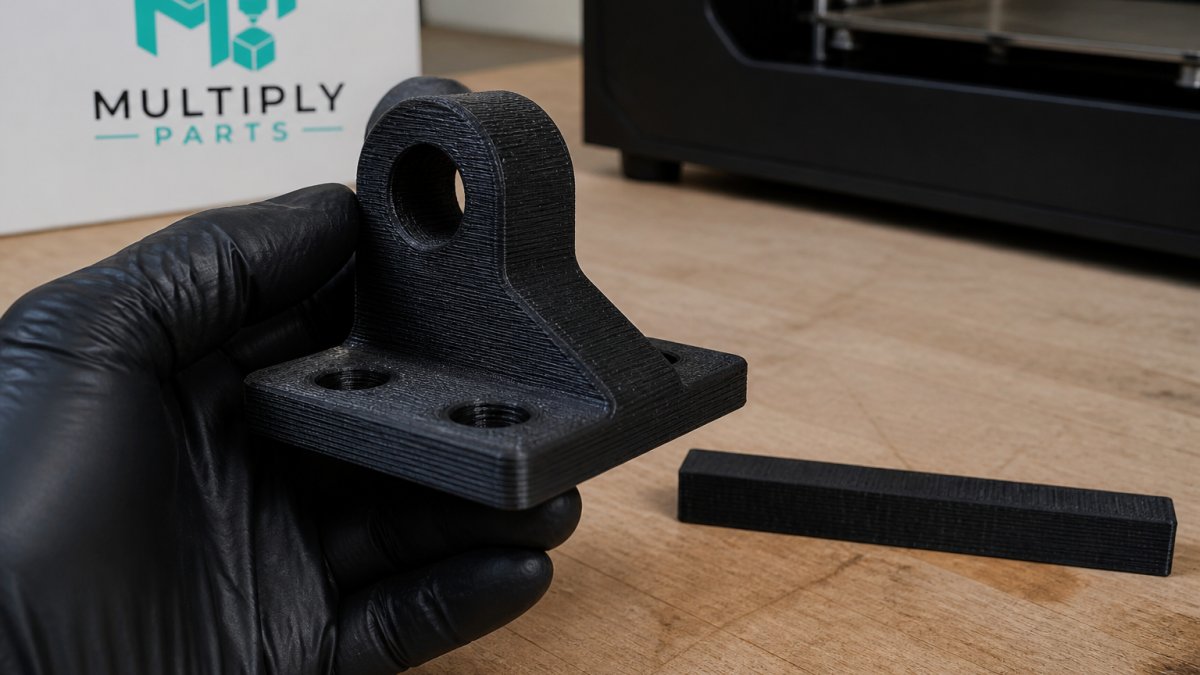
This is anisotropy: strength that changes with direction. Orient the part so loads run along the layers, not across them. Then tune the print itself:
- Raise wall thickness before raising infill
- Use more perimeters for load-bearing parts
- Match infill pattern to the load direction
- Increase layer adhesion with the right temperature
A common mistake is chasing 100% infill while leaving walls thin. Walls carry the load. Infill mostly supports them.
Step 5: Match the Best 3D Printing Material for Load-Bearing Parts to Your Environment
The best 3D printing material for load-bearing parts depends on where the part lives, not just what it does. Heat, moisture, sunlight, and chemicals change how a material performs over months of service, and they interact with the load types from Step 1 in ways a datasheet never captures.
Heat: the creep problem, not just the melting problem
Heat does not need to melt a part to ruin it. Above roughly 40-50 °C, many plastics begin to creep; they deform slowly under a constant load, even one well below their tensile strength. A PLA bracket that holds a static shelf fine at room temperature can sag over a summer if it sits in a parked car, where interior temperatures commonly reach 60 °C or higher.
Moisture: nylon’s hidden weakness
Nylon absorbs water from the air. A wet nylon part is softer and more dimensionally unstable than a dry one, and the effect is reversible only if you dry it. For load-bearing work, this means nylon parts should be dried before printing and, ideally, stored dry or sealed after. PETG and ABS absorb far less moisture, which makes them more predictable in humid or wet service.
UV: sunlight degrades the surface, then the part
Prolonged sun exposure breaks down many plastics at the surface, causing chalking, color fade, and eventually embrittlement. ABS and PLA are both vulnerable. PETG and polycarbonate resist UV somewhat better, but for parts that live outdoors year-round, a UV-stable filament or a protective coating is the more reliable answer. UV damage is cumulative, so a part that looks fine after one summer may crack after three.
Chemicals: fuels, oils, and cleaners
Fuels, oils, and many household cleaners attack some filaments. PLA is particularly susceptible to solvents and to prolonged contact with water. PETG and nylon resist many oils and fuels better, which is why they show up in automotive and sports applications. If a part will contact a specific chemical, check compatibility before committing; a material that wins on tensile strength can still fail in weeks if the wrong fluid reaches it.
Fatigue: the load type heat and moisture make worse
Fatigue is repeated loading below the material’s ultimate strength. A clip that flexes a thousand times does not need to exceed any single-load limit to fail; it just needs enough cycles. Heat and moisture accelerate fatigue by softening the material and lowering the stress it can tolerate. This is why a part that passes a one-time load test can still crack in service: the test did not reproduce the cycle count or the environment.
A practical environment checklist
Before you commit to a material, answer these for your part’s actual service life:
- What is the highest sustained temperature it will see, and for how long?
- Will it be wet, humid, or stored in a damp space?
- Will it sit in direct sun for months at a time?
- Will it contact fuels, oils, or cleaning chemicals?
- Will it flex repeatedly, and how many cycles?
For an EV accessory or a sports part that sits outdoors, these factors matter as much as tensile strength. A strong part that warps in the sun or softens in the rain is not strong for long.
Do not size a load-bearing part off a room-temperature datasheet figure if the part will run hot, wet, or in sunlight. Environmental service conditions routinely cut effective strength well below the listed value.
Step 6: Know the Limits of Reinforced Filaments and Datasheet Values
Reinforced filaments add carbon fiber or glass fiber to boost stiffness, but they come with catches. The fibers make parts stiffer and more dimensionally stable, yet often more brittle. They also wear out standard nozzles and cost more.
Datasheet values mislead in a second way. A datasheet reports the raw material, tested as a molded specimen. Your finished print is not that specimen.
Do not size a load-bearing part off a datasheet tensile figure. Printed parts commonly fail well below it because the weakest link is the bond between layers, not the material itself.
Treat datasheets as a ranking tool, not a guarantee.
Step 7: Validate the Design Before You Commit to Production
Validation means testing a real printed part under real loads before you scale. Print a prototype, load it the way it will be used, and watch where it fails.
At MultiplyParts, our instant pricing and no-minimum-order approach lets you move from a single test part to a full run without tooling delays. We specialize in sports and EV parts, where impact and heat are everyday concerns.
A short checklist before you commit:
- Test the part under its real load, not a gentle one
- Check performance hot, cold, and wet
- Confirm layer orientation matches the load
- Print three units and compare consistency
Frequently Asked Questions
Is PETG or PLA+ stronger?
It depends on the type of strength you need. PLA+ typically shows higher tensile strength and stiffness, so it resists bending under a steady pull better. PETG wins on impact resistance and ductility, meaning it flexes and absorbs shocks instead of cracking. For a part that gets bumped or dropped, PETG is usually the safer pick. For a stiff bracket that mostly holds a static load indoors, PLA+ can outperform it. Neither is universally stronger, so match the material to whether your part faces steady force or sudden impacts.
Does print orientation affect the strength of a 3D-printed part?
It affects it more than most material swaps do. FDM parts are weakest along the layer lines because interlayer bonding is never as strong as the filament itself. A bracket printed flat on its side can fail at half the load of the same bracket printed upright. When you plan a 3D print, strength and layer orientation should be decided together: rotate the part so the main load runs along the layers rather than pulling them apart. On critical parts, add wall thickness or design ribs to compensate.
How do you choose a 3D printing material for a load-bearing part?
Start with the load itself. Identify whether the part sees steady force, repeated cycling, or sudden impacts, then note the operating temperature and any moisture or chemical exposure. That shortlist points to a family: PLA+ for stiff indoor parts, PETG for tough general use, nylon or polycarbonate for high-load or high-heat work, and fiber-reinforced filaments for maximum rigidity. From there, confirm your printer can handle the material’s temperature and warping behavior, and prototype the real geometry before committing to production.
How can you test the strength of a 3D-printed part?
Print test coupons in the same material, orientation, and infill settings as the final part, then load them the way the part will actually be loaded. A simple lever-and-weight setup or a shop press with a scale can reveal where a design fails. Compare results against the datasheet only as a rough guide, since published tensile strength comes from molded specimens, not printed ones. If your part is safety-relevant or produced at volume, have the finished geometry validated by your manufacturing partner before scaling up.
Strength in 3D printing is a system, not a single number. Material, orientation, walls, and environment all decide whether a part holds up. MultiplyParts makes that easier with no minimum order quantities, instant pricing, and fast turnaround on high-performance materials. Get an Instant Quote and turn your design into a part that lasts.
