

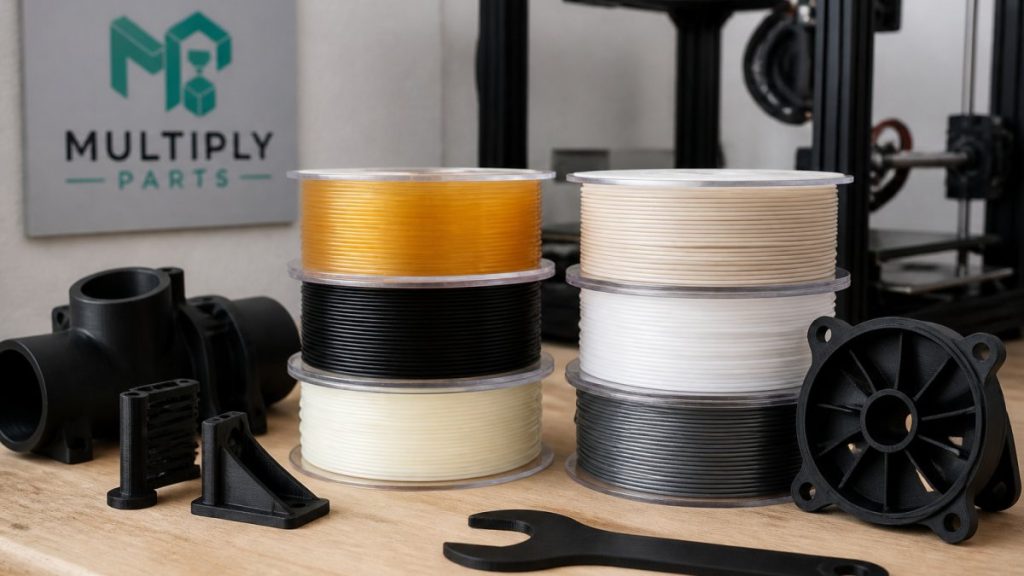
7 Best Heat Resistant 3D Printing Filaments
Table of Contents
- Heat Resistant 3D Printing Filaments: Quick Comparison
- What Is Heat Resistance in 3D Printing Materials?
- Understanding Heat Deflection Temperature of 3D Printing Materials
- 1. PEEK: Aerospace-Grade Thermal Performance
- 2. Ultem (PEI): High-Temperature Industrial Standard
- 3. Polycarbonate (PC): Balanced Heat and Impact Strength
- 4. Nylon (Polyamide): Durable Functional Parts
- 5. ASA: Weather-Resistant Outdoor Components
- Choosing the Right Heat Resistant 3D Printing Filament
- Getting Your Heat Resistant Parts to Market
- References
- Frequently Asked Questions
Last Updated: September 28, 2026
Heat Resistant 3D Printing Filaments: Quick Comparison
Standard 3D printing filaments fail under heat stress, causing warping, loss of structural integrity, and costly prototype redesigns. Heat resistant 3D printing filaments are essential for EV battery enclosures, automotive components, and industrial applications.
This guide covers heat resistant 3D printing filaments across the thermal performance spectrum, from entry-level options for moderate heat to aerospace-grade polymers for extreme environments.
Quick Picks:
- Best Overall Thermal Performance: PEEK, continuous service to 250°C, unmatched durability for extreme conditions
- Best Industrial Balance: Ultem (PEI), glass transition temperature around 217°C with inherent flame resistance
- Best for Functional Prototypes: Polycarbonate (PC), heat deflection temperature around 140°C with excellent impact strength
- Best for Durable Parts: Nylon, heat resistance to 120°C with outstanding wear resistance and low friction
- Best Budget Option for Outdoor Use: ASA, weather-resistant with heat resistance to 95°C
The choice depends on your specific application, budget, and equipment. Below, we break down each material’s thermal properties, real-world performance, and where it makes sense to use it.
What Is Heat Resistance in 3D Printing Materials?
Heat resistance measures how well a filament maintains mechanical properties and dimensional accuracy under thermal stress. Three key metrics define it:
Heat Deflection Temperature (HDT) is the temperature at which a material begins to soften under standard load, the practical ceiling for most applications. Glass Transition Temperature (Tg) is where an amorphous polymer transitions from rigid to rubbery; higher Tg means strength across wider temperature ranges. Continuous Service Temperature is the maximum temperature for indefinite operation without degradation, more realistic than peak HDT for long-term use. A material rated to 100°C HDT might fail under sustained 90°C heat; the difference between peak tolerance and continuous service temperature is critical in real designs.
Understanding Heat Deflection Temperature of 3D Printing Materials
Heat deflection temperature is the most important specification for selecting heat resistant 3D printing filaments for functional parts. The HDT test applies a standard load and measures the temperature at which a material deflects by 0.25 mm, giving a practical comparable number across materials. However, HDT doesn’t capture the full story: a material can have respectable HDT but poor creep resistance, deforming slowly over time even below that threshold. Nylon’s actual performance in sustained heat depends on the specific polyamide variant and whether it’s been annealed.
For EV battery enclosures and thermal management housings operating at 60-120°C sustained heat, use a material with HDT 20-30°C above your operating temperature. A part seeing 80°C continuous heat needs HDT of at least 110-120°C.
1. PEEK: Aerospace-Grade Thermal Performance
PEEK (polyetheretherketone) is the gold standard for heat resistant 3D printing filaments in extreme thermal environments, with continuous service temperatures to 250°C and exceptional mechanical properties. Aerospace engineers and medical device manufacturers specify PEEK when failure isn’t an option.
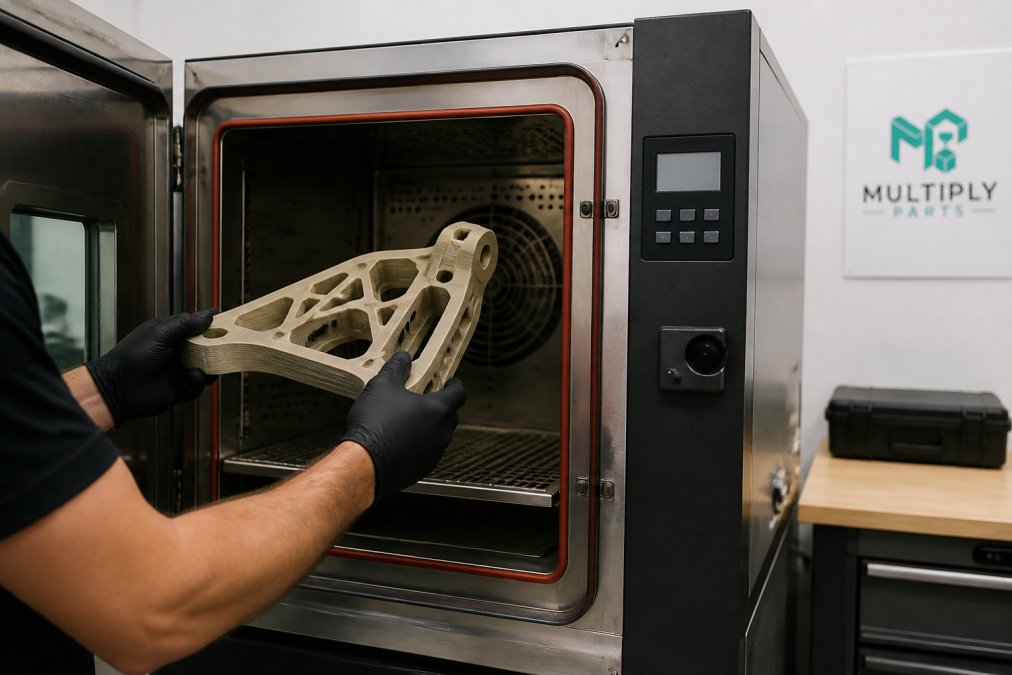
PEEK parts benefit from annealing in a controlled oven at 180-200°C for 2-4 hours. This increases crystallinity and can boost mechanical properties by 10-15%, making it worth the extra post-processing step for critical parts.
Pros:
- Continuous service temperature to 250°C
- Maintains mechanical properties under extreme heat
- High chemical resistance
- Excellent strength-to-weight ratio
Cons:
- Requires specialized high-temperature printer equipment
- Significantly higher material cost than standard filaments
- Longer print times and slower cooling requirements
- Steep learning curve for successful prints
2. Ultem (PEI): High-Temperature Industrial Standard
Ultem (polyetherimide/PEI) sits between PEEK and polycarbonate, with glass transition temperature around 217°C and continuous service to 170-180°C, delivering aerospace-grade thermal performance without exotic printer hardware.
Automotive electrical housings, industrial control panels, and consumer electronics where flame resistance and thermal stability are both required.
Pros:
- Glass transition temperature around 217°C
- Inherent flame retardance
- High dielectric strength for electrical applications
- Better than PEEK for moisture resistance in some formulations
Cons:
- Requires heated chamber to prevent warping
- Highly hygroscopic, needs dry storage
- More expensive than mid-range materials like PC or nylon
- Difficult to achieve smooth surface finishes without post-processing
3. Polycarbonate (PC): Balanced Heat and Impact Strength
Polycarbonate offers genuine heat resistance without PEEK or Ultem’s extreme cost or equipment demands. With HDT around 140°C and good impact strength, it delivers balanced thermal and mechanical performance for functional prototypes and short-run production.
| Material | HDT (°C) | Service Temp (°C) | Best For | Key Limitation |
|---|---|---|---|---|
| Polycarbonate | ~140 | 120-130 | Functional prototypes, impact-resistant parts | Prone to warping |
| Nylon | 80-120 | 100-120 | Gears, hinges, wear-resistant parts | Absorbs moisture |
| ASA | ~105 | 95 | Outdoor components, UV-resistant parts | Requires enclosure |
Pros:
- Heat deflection temperature around 140°C
- Excellent impact strength across temperature ranges
- Good dimensional accuracy with proper print settings
- Printable on standard FDM equipment with heated bed
Cons:
- Prone to warping without careful temperature management
- Requires heated bed and chamber control
- Surface finish can be rough without post-processing
- More expensive than ABS or PETG
4. Nylon (Polyamide): Durable Functional Parts
Nylon is the workhorse for functional parts needing durability, wear resistance, and moderate heat tolerance to 120°C. Its semi-crystalline structure and high tensile strength provide excellent fatigue resistance for moving parts and repeated stress. Low friction coefficient makes nylon gears mesh smoothly and wear slowly.
Nylon parts absorb moisture and can swell or lose strength if stored in humid conditions. For applications requiring dimensional stability, seal finished parts with epoxy or silicone coatings, or store in a desiccant environment.
Pros:
- Heat resistance up to 120°C (higher with annealing)
- Excellent tensile strength and wear resistance
- Low friction coefficient for mechanical parts
- Flexible compared to brittle materials like ABS
Cons:
- Highly hygroscopic, absorbs moisture from air
- Requires careful print parameter tuning
- Prone to warping without controlled cooling
- Moisture absorption affects dimensional stability
5. ASA: Weather-Resistant Outdoor Components
ASA (acrylonitrile styrene acrylate) is the practical choice for outdoor parts exposed to UV and temperature cycling, with heat resistance to 95°C and exceptional UV stability. Unlike ABS, which yellows and becomes brittle in sunlight, ASA maintains color and properties for years, making it ideal for sports equipment, outdoor EV charging enclosures, and automotive trim.
Pros:
- Exceptional UV resistance for outdoor use
- Better printability than ABS
- Heat resistance to 95°C
- Good impact strength and color retention
Cons:
- Heat resistance lower than PC or nylon
- Requires enclosure to prevent warping
- More expensive than ABS
- Not suitable for high-temperature industrial applications
Choosing the Right Heat Resistant 3D Printing Filament
Choose based on operating temperature, equipment capabilities, and budget. Above 150°C sustained: PEEK or Ultem (requires specialized hardware). 100-150°C: Polycarbonate or high-grade nylon on standard FDM with heated beds; consider annealing for 10-20°C boost. 80-100°C: Nylon for mechanical parts, ASA for outdoor components; annealing recommended. Below 80°C with outdoor durability: ASA outperforms ABS on UV resistance and printability.
| Material | Heat Deflection Temp (°C) | Service Temp (°C) | Best For | Printability |
|---|---|---|---|---|
| PEEK | 360+ | 250 | Aerospace, medical, extreme duty | Requires specialized equipment |
| Ultem (PEI) | 217 | 170-180 | Electrical housings, flame-critical parts | Requires heated chamber |
| Polycarbonate | 140 | 120-130 | Functional prototypes, impact-resistant parts | Standard FDM with heated bed |
| Nylon | 80-120 | 100-120 | Gears, hinges, wear-resistant parts | Standard FDM, requires dry storage |
| ASA | 105 | 95 | Outdoor components, UV-resistant parts | Standard FDM with enclosure |
Getting Your Heat Resistant Parts to Market
Selecting the right heat resistant 3D printing filament is only the first step; execution matters. Print parameters, cooling rates, post-processing, and quality validation determine whether parts perform as designed. Get an Instant Quote on heat resistant 3D printing filaments and let our team validate your material choice for your specific application.
References
According to the Society of Plastics Engineers technical guidance on thermoplastic properties, heat deflection temperature is measured under standard load conditions and serves as the primary thermal performance metric for engineering polymers.
Frequently Asked Questions
Which 3D filament has the highest heat deflection temperature?
PEEK offers the highest heat deflection temperature among commercial 3D printing filaments, with continuous service temperatures up to 250°C. Ultem (PEI) follows at approximately 217°C glass transition temperature. For applications requiring extreme thermal stability, PEEK is the standard choice in aerospace and medical industries, though it requires specialized high-temperature printers and represents a significant investment compared to standard materials.
How does annealing improve heat resistance in 3D printed parts?
Annealing increases crystallinity in thermoplastic materials, which strengthens layer adhesion and improves thermal stability. The process involves heating printed parts to a controlled temperature below the material’s melting point, then cooling slowly. This reduces internal stress and warping while enhancing mechanical properties. For materials like nylon and PETG, annealing can increase effective service temperature by 10-20°C and significantly improve creep resistance under sustained heat exposure.
What are the best heat resistant 3D printing materials for electric vehicle components?
For EV battery enclosures and thermal management parts, PEEK and Ultem (PEI) provide the highest performance due to their glass transition temperatures and thermal stability. Polycarbonate (PC) with a heat deflection temperature around 140°C works well for structural components not directly exposed to battery heat. Nylon handles mechanical stress in motor mounts and suspension parts. Material selection depends on exact temperature exposure, mechanical loads, and chemical resistance requirements specific to your EV application.
Can a standard 3D printer handle high-temperature filaments like PEEK?
Standard FDM printers cannot reliably print PEEK or Ultem (PEI). These materials require specialized printers with heated chambers maintaining 100-200°C, high-temperature nozzles (typically 300-400°C), and precise extrusion control. Polycarbonate and nylon can be printed on mid-range FDM printers with heated beds and enclosures, though results improve significantly with industrial-grade equipment. Professional manufacturing partners like MultiplyParts have the infrastructure to handle these advanced materials reliably at scale.
What’s the cost difference between standard and heat-resistant 3D printing filaments?
Pricing varies significantly by material. Standard PETG costs around $35 CAD/kg, while ABS runs approximately $30 CAD/kg. Polycarbonate and Nylon range from $50-60 CAD/kg. PEEK and Ultem command premium pricing due to specialized handling requirements and limited supplier availability. Beyond raw material cost, high-temperature filaments often require longer print times, specialized equipment, and post-processing like annealing, which affects total project cost. MultiplyParts offers instant pricing to help you evaluate options for your specific application.
