
Implementing Additive Manufacturing for Supply Chain Agility
Table of Contents
- Additive Manufacturing Supply Chain Benefits: Resilience, Agility, and Cost Control
- 3D Printing vs Injection Molding Cost: When Additive Manufacturing Wins
- On-Demand Manufacturing Services: A Practical Path to Agility
- What Most Teams Get Wrong About Implementation
- Frequently Asked Questions
Last Updated: September 28, 2026
Additive Manufacturing Supply Chain Benefits: Resilience, Agility, and Cost Control
Additive manufacturing builds parts layer by layer from a digital file, so teams print what they need instead of waiting on overseas tooling, close to where parts are used. That delivers three wins: resilience (production keeps moving when a supplier fails), agility (change a design and print it the same day), and cost control (no molds, no minimums, no dead stock).
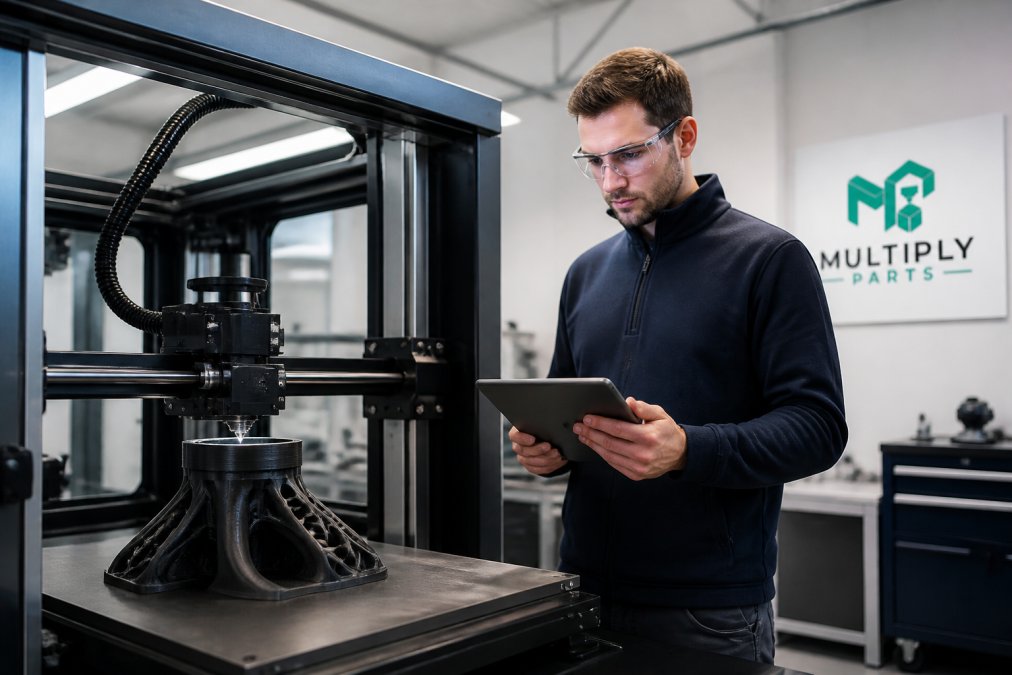
Supply chain resilience means keeping operations running through shocks. Additive manufacturing spreads production across many small sites instead of one large plant, often a printer near your assembly line, printing parts on demand.
The strongest supply chain is not the cheapest one. It is the one that keeps running when something breaks.
3D Printing vs Injection Molding Cost: When Additive Manufacturing Wins
3D printing wins on cost for low volumes, fast turnaround, or design changes; injection molding wins for hundreds of thousands of identical parts. Injection molding carries a large upfront tooling bill that only pays off at high volumes, while additive manufacturing skips the mold entirely: you pay per part, flat whether you order 5 units or 500.
| Factor | 3D Printing | Injection Molding |
|---|---|---|
| Upfront tooling cost | None | High, paid before production |
| Best volume | Low to mid runs | Very high runs |
| Design changes | Fast, low cost | Slow, costly rework |
| Lead time to first part | Days | Weeks to months |
| Material choice | Wide, growing range | Limited to mold-safe plastics |
Additive manufacturing wins on short runs, custom parts, and anything still in development. A common mistake is ordering a mold too early: if the design isn’t frozen, that mold becomes scrap. Print first batches, test them, then commit to tooling.
Committing to an expensive mold before your design is final is the fastest way to waste money. Test with printed parts first, then tool up.
On-Demand Manufacturing Services: A Practical Path to Agility
On-demand manufacturing means ordering parts as you need them, not months ahead: a supplier prints and ships when your order lands, so you hold less stock, free up cash, and react faster to demand.
To start: pick one non-critical part, upload your CAD file for an instant quote, order a small batch to check fit and finish, compare lead time and cost against your current supplier, then scale up.
MultiplyParts was built for exactly this: instant pricing, no minimum order quantities, and fast turnaround, so a startup can order five parts and a growing brand five hundred without changing suppliers. The benefits stack up fast, lower inventory carrying costs, less capital tied up in stock, and faster response to demand spikes.
National Research Council of Canada industrial research programs
What Most Teams Get Wrong About Implementation
Most teams treat additive manufacturing as a drop-in replacement for their old process. It isn’t, it’s a different way of planning production, and the real work is the process around the printer. Three things trip teams up: skipping workforce training, ignoring cybersecurity, and having no ROI model.
Build a simple ROI sheet before you scale. List tooling saved, hours saved, and stock reduced. If the numbers do not add up, fix the process before you buy more machines.
Frequently Asked Questions
How does additive manufacturing improve supply chain resilience?
Additive manufacturing improves supply chain resilience by enabling decentralized production and digital inventory. Instead of relying on a single overseas factory, you can print parts closer to the point of use. This reduces exposure to shipping delays, tariffs, and geopolitical disruption. A digital file can be sent to any compatible printer, so a machine breakdown or port closure does not halt production. For Canadian manufacturers, this means shorter, more controllable supply lines and the ability to respond quickly when demand spikes or a traditional supplier fails.
What are the primary benefits of 3D printing for supply chain agility?
The main benefits are faster lead times, lower inventory costs, and design flexibility. 3D printing eliminates tooling, so a new or revised part can go from file to finished piece in days rather than weeks. You can produce on demand, which cuts the need to hold large stocks of slow-moving parts. It also supports mass customization and part consolidation, letting you combine multiple components into one printed piece. These factors give operations teams the ability to react to changes without long production runs or minimum order quantities.
What are the cost implications of implementing additive manufacturing?
Upfront costs include printers, materials, and training, but additive manufacturing can lower total supply chain costs by reducing tooling, inventory, and logistics expenses. For low-to-mid volumes, 3D printing often costs less than injection molding because there is no mold to make. Pricing depends on part size, material, and quantity. For a specific project, request an instant quote from a service like MultiplyParts to compare against traditional methods. Many businesses start with a small pilot to validate savings before scaling.
Supply chain disruption is not a matter of if, but when. MultiplyParts helps you prepare for it with instant pricing, no minimum order quantities, and fast turnaround on high-quality 3D printed parts for sports and EV applications. Our Canadian team turns your designs into production-ready parts without the tooling delays. Get started with MultiplyParts and build a supply chain that keeps moving.
