
Why Choose On-Demand Manufacturing: 2026 Guide
Table of Contents
- What On-Demand Manufacturing Means for Product Teams
- How On-Demand Manufacturing Works: From CAD to Part
- 3D Printing vs Injection Molding Cost: A Decision Framework
- On-Demand Manufacturing Supply Chain Optimization: Building Resilience
- Integrating On-Demand Production With Your ERP and PLM Systems
- Risks, Compliance, and Quality Assurance in On-Demand Production
- Common Mistakes When Switching to On-Demand Manufacturing
- Frequently Asked Questions
Last Updated: September 19, 2026
What On-Demand Manufacturing Means for Product Teams
On-demand manufacturing is a production model where parts are made only after an order is placed, typically using digital files and flexible processes instead of large pre-built inventories. For product teams, it replaces the gamble of forecasting demand with the certainty of making what’s actually been sold.
That shift matters more than most guides admit. The traditional model asks you to predict the future, commit capital, and hope the warehouse doesn’t fill up with the wrong SKU. On-demand flips it: you produce against real orders, iterate faster, and let the design change without scrapping thousands of units.
This guide from MultiplyParts breaks down the mechanics, the cost trade-offs between 3D printing and injection molding, the supply chain upside, and the risks nobody warns you about.
On-demand manufacturing isn’t a smaller version of traditional production. It’s a different operating logic: order first, make second, hold almost no inventory.
How On-Demand Manufacturing Works: From CAD to Part
The workflow is short and repeatable: you upload a CAD file, the platform quotes it automatically, and production starts once you approve. A typical cycle runs from digital model to finished part in days, not weeks.
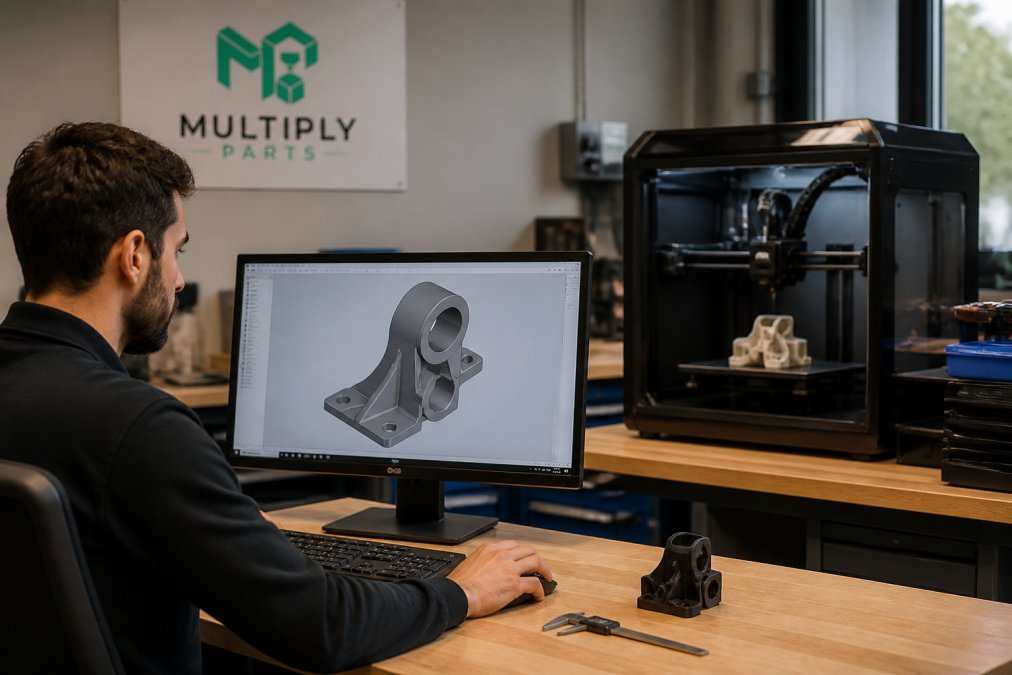
Here’s the sequence most teams follow:
- Finalize a manufacturable CAD model (STEP or STL depending on process)
- Upload for automated quoting, which prices geometry, material, and quantity
- Select material and finish based on the part’s real operating conditions
- Approve the quote and enter the production queue
- Receive the part, inspect it, and iterate if needed
3D Printing vs Injection Molding Cost: A Decision Framework
The 3D printing vs injection molding cost question has a clear answer at the extremes and a calculable answer in the middle. The mistake most teams make is treating it as a rule of thumb. It is a break-even calculation, and once you know the inputs, you can run it in five minutes.
The Break-Even Mechanism
Break-even units = tooling cost ÷ (3D-printed per-part cost − molded per-part cost)
When 3D Printing Wins on Cost
At low volumes, 3D printing wins because there is no tooling to amortize. You pay per part, not per mold, so the economics stay sane whether you make 5 units or 500. Complex geometry, internal channels, lattice structures, and one-off custom parts cost the same as simple ones, there is no penalty for complexity, which is the opposite of molding.
When Injection Molding Becomes Cheaper
Injection molding becomes cheaper once the per-part savings from tooling outweigh the upfront tooling cost. Beyond break-even, molded parts typically cost a fraction of printed parts at volume, and the gap widens as quantity climbs. The catch is that the tool is committed to one geometry: a design change means either a new tool or a modification, both of which carry cost and lead time.
The Decision Matrix
| Factor | 3D Printing | Injection Molding |
|---|---|---|
| Upfront tooling | None | High |
| Best volume | Low to mid | High |
| Per-part cost curve | Flat | Falls with volume |
| Design changes | Cheap, fast | Costly, slow |
| Complex geometry | No penalty | Adds cost |
| Lead time to first part | Days | Weeks |
| Material range | Engineering thermoplastics, resins, metals | Broad production thermoplastics |
| Surface finish | Good, process-dependent | Excellent, mold-dependent |
How to Run the Calculation for Your Part
- Get an instant 3D printing quote at your target volume.
- Get a molded per-part quote plus the tooling quote at the same volume.
- Subtract the molded per-part cost from the printed per-part cost.
- Divide the tooling cost by that difference.
- Compare the result to your realistic annual demand, not your optimistic demand.
If your realistic demand sits below break-even, printing is the lower-cost path. If it sits well above, molding wins on unit economics, provided the design is frozen.
If you’re unsure whether you’ve hit the break-even volume, prototype in 3D printing first. You’ll validate the design before committing tooling dollars, and the printed parts often serve as your first production run. Re-run the calculation once the design stops changing, that is the moment tooling starts to make sense.
The most common costing error is comparing a molded per-part price against a printed per-part price without adding the tooling cost back in. Tooling is real money, and it is only recovered through volume. If demand never arrives, that cost is stranded.
On-Demand Manufacturing Supply Chain Optimization: Building Resilience
On-demand manufacturing supply chain optimization comes down to replacing forecast-driven inventory with order-driven production. Instead of stocking finished goods, you hold digital files and produce against real demand.
Integrating On-Demand Production With Your ERP and PLM Systems
Integration is where the promise meets the plumbing. On-demand production works best when your ERP and PLM systems talk to your manufacturing partner, so quotes, orders, and revisions flow without manual re-entry.
A practical integration looks like this:
- PLM: the CAD file and revision history stay the single source of truth
- ERP: purchase orders, cost tracking, and inventory update automatically
- Quoting: automated quoting pulls part data directly from your file
- Tracking: real-time tracking feeds status back into your systems
Risks, Compliance, and Quality Assurance in On-Demand Production
Most guides sell on-demand manufacturing as risk-free. It isn’t. The risks are different from traditional manufacturing, not absent, and the teams that succeed are the ones that name them and build controls around them. This is the part of the switch that procurement managers actually lose sleep over.
Quality Consistency at Scale
The first concern is whether a part that prints perfectly at 50 units holds the same tolerance at 500. The answer depends entirely on process control, not on the technology. Ask any manufacturing partner three questions before you scale:
- Is there a documented process control plan for the material and process?
- What inspection criteria apply, and are they written into the order?
- What happens when a part fails inspection, rework, scrap, or credit?
Compliance: Know Which Standards Apply
Compliance is application-specific, and the burden is on you to know which standards your part must meet. Common frameworks include:
- ISO 9001, general quality management, the baseline most industrial buyers expect
- ISO 13485, medical devices, where traceability and process validation are mandatory
- AS9100, aerospace, with strict configuration control and material traceability
- IATF 16949, automotive production parts, with PPAP-style documentation
IP Protection: The Risk Nobody Prices In
Uploading CAD files to a third-party platform means your design leaves your building. That is a real exposure, and it deserves a real answer. Before you upload anything sensitive, confirm:
- Who owns the files, and what the platform’s data-retention policy is
- Whether files are encrypted in transit and at rest
- Whether the platform will sign a mutual NDA
- Whether production is subcontracted, and to whom
Vendor Reliability and Single-Point Risk
Concentrating production in one facility, however reliable, creates single-point risk. The mitigation is straightforward: qualify more than one production path and keep your digital files portable. Because on-demand production is file-driven, switching or duplicating a production path is far cheaper than re-tooling, but only if your data is clean and your partner does not lock it in a proprietary format.
A Practical Vendor-Qualification Checklist
Run this before you commit volume:
- Request the quality certifications relevant to your industry.
- Ask for a sample inspection report and a material certificate.
- Confirm the IP and data-handling terms in writing.
- Run a pilot order and inspect it against your own criteria.
- Identify a second qualified production path before you scale.
Skipping a formal quality agreement before scaling is the most expensive shortcut in on-demand manufacturing. Without defined tolerances and inspection criteria, you’ll discover a quality problem at 500 units instead of 5.
The risks of on-demand manufacturing are manageable, but only if you name them. Quality agreements, named compliance standards, IP terms, and a second qualified vendor are the four controls that separate a smooth scale-up from an expensive lesson.
Common Mistakes When Switching to On-Demand Manufacturing
Most failures aren’t technology failures. They’re process failures, and they’re predictable.
- Designing for the wrong process. A part optimized for injection molding may print poorly and vice versa. Design for manufacturing means designing for the specific process you’ve chosen.
- Ignoring material validation. Assuming a material works for your application without checking heat resistance, impact strength, or chemical compatibility is how parts fail in the field.
- Treating the first quote as final. Revisions change pricing. Budget for iteration.
- Skipping the pilot run. Scaling from 50 to 500 units without a validated process invites inconsistency.
- Choosing on price alone. The cheapest quote often hides slower lead times or weaker quality control.
Frequently Asked Questions
How does on-demand manufacturing reduce inventory costs?
On-demand manufacturing produces parts only when orders come in, so you avoid warehousing finished goods that may sit unsold for months. Instead of forecasting demand and committing to large production runs, you hold digital inventory (your CAD files) and trigger production as needed. This cuts storage fees, reduces capital tied up in stock, and lowers the risk of write-offs from obsolete or unsold inventory.
Is on-demand manufacturing suitable for high-volume production?
It depends on the method. 3D printing works well for low-to-mid volumes, typically up to a few thousand units per year, and for complex geometries that injection molding cannot easily produce. For very high volumes, injection molding usually becomes more cost-effective per unit. Many teams use a hybrid approach: on-demand for prototyping and bridge production, then transition to tooling once volumes justify it.
What are the primary risks of switching to an on-demand model?
The main risks include supplier dependency, quality consistency across batches, and potential lead-time variability if a partner is capacity-constrained. Mitigate these by qualifying at least two suppliers, requesting first-article inspection reports, and building buffer stock for critical components. Also review your supplier agreements for delivery guarantees and quality clauses before committing to production volumes.
How does on-demand manufacturing compare to traditional mass production?
Traditional mass production relies on large batch sizes to spread tooling costs, which means long lead times and high minimum order quantities. On-demand manufacturing skips hard tooling for many processes, enabling small-batch production, faster iteration, and lower upfront investment. The trade-off is a higher per-unit cost at very high volumes. For startups and short-run production, on-demand often delivers better total cost of ownership.
