
Alternatives to High MOQ Manufacturing: 7 Options
Table of Contents
- Why High MOQ Manufacturing Blocks New Products
- Small-Batch Manufacturing: Lower Volume, Lower Risk
- On-Demand Manufacturing: Produce Only What You Sell
- 3D Printing for Low-Volume Production: No Tooling Required
- How to Negotiate MOQ with Suppliers
- Comparing Your Alternatives: Cost, Lead Time, and Risk
- Frequently Asked Questions
Last Updated: October 12, 2026
Why High MOQ Manufacturing Blocks New Products
High MOQ manufacturing is a production model where a factory will only accept an order above a set floor, often in the thousands of units. That floor exists to protect the factory’s margins, but it forces the buyer to fund a full production run before a single sale happens.
The Real Cost of Minimum Order Quantity
The headline number is rarely the real bill. A high minimum ties up cash in tooling, materials, and freight, then locks that cash into inventory that may sit for months. Many small brands find that the true cost of a first run is two to three times the quoted unit price once setup, storage, and unsold stock are counted. That is capital you cannot spend on marketing or the next design.
Treating the unit price as your total cost is the most common mistake we see. A cheap per-piece quote on 5,000 units can leave you with 4,200 unsold parts and no budget left to sell them.
Small-Batch Manufacturing: Lower Volume, Lower Risk
Small-batch manufacturing is production of a limited quantity of parts, usually enough to test a market or fulfill early orders rather than to stock a warehouse. It trades a higher per-piece cost for dramatically lower financial exposure. For a first run, that trade usually wins.
What Counts as a Small Production Run
There is no fixed number, but for most physical products a small production run means tens to low hundreds of units. The goal is not efficiency; it is information. You want enough parts to sell, gather feedback, and confirm your design holds up in real use. Once demand is proven, you scale.
| Approach | Typical First-Run Size | Main Trade-Off |
|---|---|---|
| High MOQ factory | Thousands of units | Low unit cost, high risk |
| Small-batch | Tens to low hundreds | Higher unit cost, low risk |
| On-demand | One unit at a time | No inventory, higher per-piece cost |
| 3D printing | One to hundreds | No tooling, material limits |
On-Demand Manufacturing: Produce Only What You Sell
On-demand manufacturing produces each item only after a customer orders it, so you hold no finished inventory. The model splits into two broad families, and the difference matters more than the label:
- Print-on-demand (POD): A supplier prints or decorates a blank substrate, apparel, mugs, phone cases, posters, packaging inserts, after the order lands. The blank is usually a stock product the supplier already stocks in depth.
- Made-to-order production: A workshop or contract manufacturer builds the item to your specification after the order, often using digital cutting, CNC, or 3D printing rather than a dedicated mold.
Both remove the overproduction problem, but neither removes cost. You are paying for setup, machine time, and labor on a run of one, so the per-piece price is typically several times the high-MOQ equivalent. Lead time per order is also longer, because nothing is pulled from a shelf. Optimizing your production workflow remains the most effective way to reduce manufacturing lead times while mitigating the inherent inefficiencies of small-batch processing.
Where On-Demand Works, and Where It Breaks
On-demand fits products where the design is fixed, the substrate is standard, and the customer will wait. Custom phone cases, engraved accessories, made-to-order furniture in a small shop, and decorated drinkware all fit. It breaks down when:
- The product needs a custom mold or die. Tooling is a fixed cost that has to be amortized across units. At one unit, it never amortizes.
- The material is regulated or certified. Food-contact packaging, children’s products, and electrical goods often require batch testing or certification that a one-off run cannot economically support.
- Margins are thin. If your retail price is close to your landed cost, on-demand’s per-piece premium can erase the margin entirely.
- Volume spikes. A viral moment can overwhelm a made-to-order shop that has no buffer stock and no surge capacity.
The Real Trade-Off: Inventory Risk vs. Unit Economics
A useful way to compare on-demand against a small batch is to ask what you are actually buying. A small batch buys you a lower unit cost in exchange for inventory risk. On-demand buys you zero inventory risk in exchange for a higher unit cost and a longer per-order lead time. Neither is universally better; the right answer depends on your sell-through confidence and your cash position.
On-demand is a demand-testing tool, not a scaling strategy. Use it to prove a design sells, then move the proven SKU to a small batch or contract run once volume justifies the tooling.
Canada Revenue Agency guidance on reporting income from online sales
3D Printing for Low-Volume Production: No Tooling Required
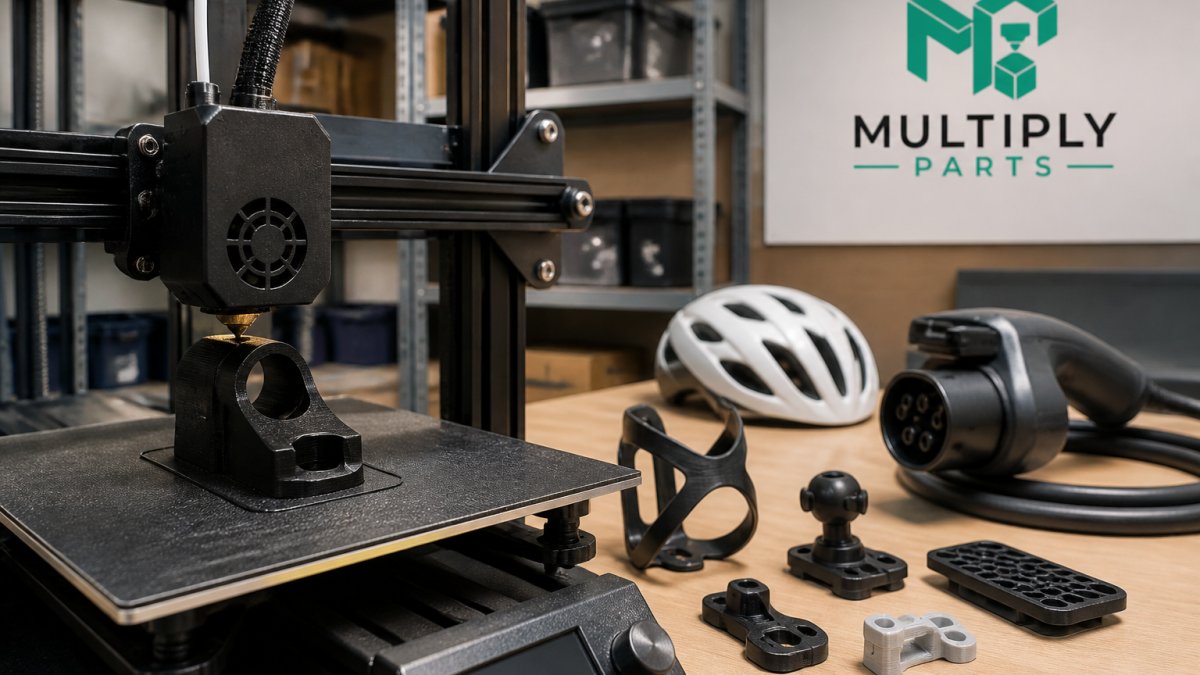
3D printing for low-volume production removes tooling from the equation altogether. There are no molds to cut, so the first unit and the five-hundredth cost roughly the same to set up. That makes it the fastest way to move from a CAD file to a physical part you can test, sell, or hand to a customer.
Materials and Quality Control for Functional Parts
Material choice decides whether a printed part survives real use. For parts that take impact or heat, the filament matters as much as the design. Quality control at low volume is about consistency: the same file, the same material, and the same machine settings should produce the same part every time. This is where an experienced partner earns its keep.
Ask for a material recommendation based on your part’s actual load, not its category. A bracket that holds a light housing and one that holds a battery enclosure need very different filaments.
How to Negotiate MOQ with Suppliers
You can often move a supplier’s minimum without changing suppliers. The key is to understand what the minimum is protecting: the supplier’s setup cost, their material purchasing commitment, and their scheduling certainty. Negotiation works when you reduce one of those three, not when you simply ask for a smaller number.
The Levers That Actually Move a Minimum
- Commit to annual volume instead of a first order. A supplier who sees a 12-month plan can justify a smaller first run because the setup cost is spread across the relationship, not the first purchase order.
- Accept a stock material or standard colorway. Custom-dyed fabric, custom Pantone matches, and custom extrusion profiles all carry their own minimums from the supplier’s upstream vendors. Switching to a stock option can drop the floor dramatically.
- Pay a setup or tooling fee separately. If the supplier’s real concern is recovering mold or die cost, paying that fee up front removes their reason to insist on volume.
- Split deliveries against a single commitment. You commit to the full quantity but take it in scheduled releases. The supplier gets a firm order; you get cash flow relief and less warehouse exposure.
- Start with a paid sample or pilot run. A paid sample order with a written plan to scale is a low-risk way for the supplier to test you as a customer.
- Reduce the number of SKUs in the first run. One color, one size, one material variant can cut the minimum for that variant even if the supplier’s overall floor stays the same.
What a Refusal Tells You
A supplier who will not move at all, even when you offer a setup fee or an annual commitment, is telling you something useful about how they will treat you later. Rigid minimums often signal rigid change orders, rigid lead times, and rigid quality conversations. That is worth knowing before you wire a deposit.
A Practical Sequence
- Ask what drives the minimum, setup, material, or scheduling.
- Offer the lever that matches the answer.
- Put the agreed terms in writing, including reorder expectations.
- Treat the first order as a test of communication, not just of product.
Negotiate the reorder terms at the same time as the first order. A supplier who agrees to a lower first minimum but quotes a punitive reorder minimum has not really moved.
Canadian Border Services Agency guidance on importing commercial goods
Comparing Your Alternatives: Cost, Lead Time, and Risk
Choosing between these options comes down to three numbers: total landed cost, lead time, and how much unsold inventory you can afford to carry. Match the method to your stage, not to the lowest unit price.
| Stage | Best Fit | Why |
|---|---|---|
| Idea or prototype | 3D printing | No tooling, fast iteration |
| Testing demand | Small-batch or on-demand | Low inventory risk |
| Proven, steady sales | Contract manufacturing | Lowest unit cost at scale |
Total Landed Cost and Break-Even Analysis
Total landed cost is the full cost to get a part into a customer’s hands: unit price, tooling, freight, duties, storage, and the cost of unsold units. A high-MOQ quote can look cheapest per piece and still lose money if half the run never sells. Break-even is the point where revenue from sold units covers that full cost. Calculate it before you commit, using your realistic sell-through, not your best-case one.
That is the whole argument for alternatives to high MOQ manufacturing: they let you buy information cheaply before you buy inventory expensively. MultiplyParts offers no minimum order quantities, instant pricing, and fast turnaround, with 3D printing specialized for sports and EV parts and a range of high-performance materials. Get an Instant Quote →
Frequently Asked Questions
What are the alternatives to high-MOQ manufacturing?
The main alternatives are small-batch manufacturing, on-demand production, 3D printing for low-volume runs, and stock or semi-custom products. Each reduces your upfront commitment compared to traditional high MOQ manufacturing. For example, 3D printing requires no tooling and lets you produce one unit or 500. Small-batch manufacturing uses existing moulds or flexible processes to keep minimums low. The right choice depends on your product, budget, and how much customization you need.
Is low-MOQ manufacturing more expensive per unit?
Yes, per-piece cost is usually higher with low MOQ because setup costs are spread over fewer units. However, the total cash outlay is much lower, and you avoid the risk of unsold inventory. For a first production run, paying more per part but ordering only what you can sell often makes better financial sense. As you scale and reorder, per-unit costs drop. Focus on total landed cost, not just unit price.
How can I negotiate a lower MOQ with a manufacturer?
Start by asking about their setup costs and whether they can run your order alongside existing production. Offer to pay a higher per-unit price or cover tooling costs upfront. If your design uses their stock materials or existing moulds, they may waive minimums. You can also propose a phased order: a small first run to validate demand, then a larger reorder. Clear communication about your growth plans helps suppliers see long-term value.
Can 3D printing replace injection molding for small production runs?
For low volumes, 3D printing is often the better choice. It eliminates tooling costs, which can run into thousands of dollars, and lets you iterate designs quickly. Injection molding becomes more cost-effective at higher volumes, typically above several thousand units. For a first run, market validation, or custom parts, 3D printing delivers functional parts without the risk of overproduction. As demand grows, you can transition to molding.
