
Alternatives to Traditional CNC Machining for Parts
Table of Contents
- Why Engineers Are Looking Beyond Traditional CNC Machining
- 3D Printing vs CNC Machining: Where Each Process Wins
- Injection Molding vs CNC Machining Cost: The Break-Even Point
- Other CNC Machining Alternatives: Laser Cutting, Water Jet, and Casting
- Manufacturing Methods for Low-Volume Production: A Practical Comparison
- How to Choose a Manufacturing Process for Your Part
- Post-Processing and Sustainability Considerations
- Conclusion: Matching the Process to the Project
- Frequently Asked Questions
Last Updated: October 13, 2026
Why Engineers Are Looking Beyond Traditional CNC Machining
Search interest in alternatives to traditional CNC machining for parts keeps climbing, and the reason is practical rather than fashionable. Subtractive manufacturing removes material from a solid block, which delivers excellent tolerances and surface finish, but it also ties up machine time, tooling, and fixturing on every job.
At MultiplyParts, we see this shift every week: designers arrive with a working CAD file and a modest budget, then discover that a machining quote assumes volumes they will never reach. According to Natural Resources Canada’s industrial materials program, efficient use of raw material is now a core competitiveness issue for manufacturers, which makes material waste a real line item rather than an afterthought.
Below, we break down where each process wins, where it loses, and how to pick one without guessing.
3D Printing vs CNC Machining: Where Each Process Wins
The honest answer is that neither process wins overall. 3D printing, or additive manufacturing, builds a part layer by layer and excels at geometric complexity, while CNC milling and CNC turning cut away material and excel at dimensional accuracy and repeatability. The decision comes down to your part geometry, your production volume, and how tight your tolerances actually need to be.
When Additive Manufacturing Beats Subtractive Manufacturing
Additive wins when the design would be expensive or impossible to machine. Internal channels, lattice structures, and organic shapes that would require multiple setups and custom fixturing on a mill often print in a single run with no tooling at all. One-off production and small-batch runs also favor printing, because setup time drops to near zero.
There is a trade-off in mechanical properties. Printed parts are typically anisotropic, meaning strength varies by direction, while machined metal is isotropic. For a sports mount or a housing that takes impact, that difference matters and should shape your material choice.
When CNC Still Makes More Sense
CNC remains the better call for hardened materials, tight tolerances, and high-volume runs where unit cost falls as volume rises. If your part needs a mirror surface finish straight off the machine, or must hold dimensional accuracy across thousands of identical units, subtractive manufacturing is hard to beat. Laser cutting and water jet cutting cover flat profiles well, but neither produces true three-dimensional geometry.
A common mistake is requesting tolerances tighter than the part needs. Every extra decimal place adds machining operations, inspection time, and cost. Specify what the assembly actually requires, not the tightest number you can type.
Injection Molding vs CNC Machining Cost: The Break-Even Point
Injection molding beats CNC on unit cost once volume is high enough to absorb tooling, but that threshold is higher than most first-time buyers expect.
The break-even point is not a single number, it is the volume at which the mold’s fixed cost, divided across units, falls below the per-part savings molding delivers over machining. The mechanism looks like this:
- Mold cost is fixed and front-loaded. A single-cavity mold for a modest part typically runs into the tens of thousands of dollars, and a multi-cavity tool multiplies that. That cost is paid once, before the first good part ships.
- Per-part cost drops sharply at volume. Once the tool exists, each shot produces one or more parts in seconds, so material and machine time dominate unit cost rather than labor and programming.
- CNC carries no tooling but higher per-part cost. Programming, fixturing, and cycle time are incurred on every run, so unit cost stays roughly flat whether you make 10 parts or 10,000.
A practical way to model it: estimate your mold cost, estimate the per-part savings molding gives you versus machining, then divide mold cost by per-part savings.
| Method | Upfront Tooling | Best Volume Range | Design Changes |
|---|---|---|---|
| 3D printing | None | One-offs to low hundreds | Easy, no retooling |
| CNC machining | Low to moderate | Tens to low thousands | Moderate, reprogram |
| Injection molding | High | Thousands and up | Expensive, new mold |
| Laser / water jet | None | Flat parts, any volume | Easy, new program |
Two factors push the break-even higher than the raw math suggests.
The practical rule: if your annual volume is small and your design is still changing, avoid molding. For everything in between, look at low-volume production methods first.
Committing to injection molding before your design is frozen is one of the most expensive mistakes in hardware. A single late change can mean a new mold and weeks of lost lead time.
Break-even quantity = mold cost ÷ per-part savings versus machining. Run that number against your realistic lifetime volume before you commit to a tool.
Other CNC Machining Alternatives: Laser Cutting, Water Jet, and Casting
Laser cutting and water jet cutting are subtractive cousins of CNC that handle flat sheet stock quickly, with laser suited to thin metals and water jet better for thicker or heat-sensitive materials. Casting sits at the opposite end: it needs a pattern or die, which makes it economical only at volume.
Each alternative carries its own constraints. Laser cutting leaves a heat-affected edge that may need post-processing. Water jet cutting avoids heat but is slower on intricate profiles. Casting delivers good mechanical properties in production but poor economics for one-off parts. Matching the process to the part geometry, not to habit, is what keeps lead time and unit cost down.
Manufacturing Methods for Low-Volume Production: A Practical Comparison
Low-volume production is where the alternatives to traditional CNC machining for parts earn their place. At low volumes, the winning method is usually the one with the least setup time and the fewest fixed costs, not the one with the lowest theoretical unit price at scale.
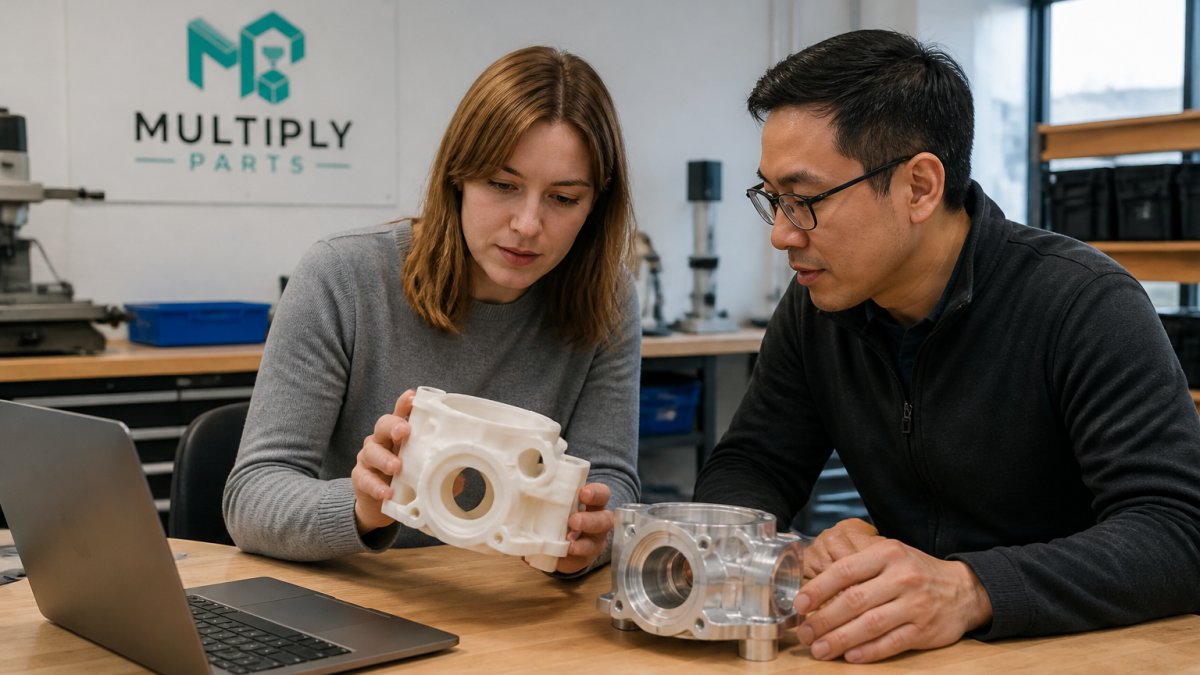
For teams that need to move from concept to a physical part quickly, MultiplyParts offers instant pricing and no minimum order quantities, which removes the volume penalty that usually blocks small runs. That matters most for sports and EV accessory makers testing a design before committing to tooling.
Small-Batch vs High-Volume Economic Thresholds
Small-batch production favors additive and CNC because neither demands a mold. High-volume production favors molding and casting because fixed costs spread across many units. The crossover point depends on part complexity, material, and how much post-processing each option needs. There is no universal number, so model your own total cost of ownership rather than trusting a rule of thumb.
How to Choose a Manufacturing Process for Your Part
Choosing a manufacturing process is a structured decision, not a gut call. Work through four filters in order: part geometry, required tolerances and surface finish, production volume, and total cost including post-processing. The first filter that eliminates an option usually decides the answer.
- Map the part geometry and flag any features that need multiple setups to machine
- Define the tolerances and surface finish the assembly genuinely requires
- Estimate production volume and how likely the design is to change
- Compare total cost of ownership, including fixturing, tool wear, and finishing
- Confirm material properties match the application, especially for impact or heat
Startups and small teams that need rapid prototyping with no minimum order quantities and fast turnaround, particularly in sports and EV accessory work.
Hybrid Manufacturing Workflows: Combining Processes
Hybrid workflows combine processes instead of picking one. A common pattern is printing a near-net shape, then machining only the critical mating surfaces to hit tight tolerances. This cuts material removal time and tool wear while keeping dimensional accuracy where it counts. For complex parts, hybrid approaches often beat any single method on both lead time and cost.
Post-Processing and Sustainability Considerations
Most comparisons stop at unit cost and cycle time. The two factors that actually decide total cost of ownership, and that almost no competitor covers in depth, are post-processing labor and environmental impact. Both deserve a place in your cost model from day one.
Post-Processing: The Hidden Labor Line
Post-processing is the cost most first-time buyers forget, and it is where additive and subtractive diverge most sharply.
3D printing typically requires the most hands-on work per part:
- Support structure removal, which can be manual or require a dedicated station
- Surface smoothing, sanding, tumbling, or vapor smoothing, because as-printed surfaces are layered
- Curing for resin processes, and sometimes heat treatment for metal parts
- Dimensional inspection, since printed tolerances drift more than machined ones
CNC machining arrives closer to finished, but is not free of finishing:
- Deburring and edge breaking on cut features
- Anodizing, plating, or painting when the application calls for it
- Inspection, though machined parts usually hold tolerance well enough that sampling suffices
Casting needs the most downstream work of all: gate and runner removal, flash trimming, and often machining of critical surfaces that the casting process cannot hold to tolerance.
The takeaway is that a printed part’s sticker price understates its true cost more than a machined part’s does. When you compare quotes, add the labor hours each process demands after the part comes off the machine.
Sustainability: Subtractive vs. Additive Waste
Sustainability is the second blind spot, and it is where this article departs from the standard comparison. The two process families waste material in fundamentally different ways.
Subtractive manufacturing generates chips and swarf.
Additive manufacturing uses material more efficiently in the sense that it places material only where the part needs it, but support structures, failed prints, and powder that cannot be reused become waste streams that are harder to recycle.
According to Environment and Climate Change Canada’s pollution prevention guidance, reducing waste at the source is the most effective way to cut environmental impact.
When you compare quotes, ask each supplier what happens to their scrap and support material. A process with a higher unit price but a closed-loop waste stream can be the better choice for teams with sustainability targets.
Putting It Together
Build your total cost of ownership from four lines: unit price, post-processing labor, tooling amortization, and waste handling. The process that wins on unit price often loses once the other three are added. Model all four before you commit.
Conclusion: Matching the Process to the Project
The right manufacturing method depends on your part, not on which process is trending. Additive manufacturing wins on complexity and low volume; CNC wins on tolerances and repeatability; molding wins at scale. Model the total cost, including post-processing, before you commit.
If you are prototyping a new invention or scaling a sports or EV accessory line, MultiplyParts offers instant pricing, no minimum order quantities, fast turnaround times, and many high-performance materials, all manufactured in Canada. Get an Instant Quote and turn your CAD file into a finished part.
Frequently Asked Questions
What are the best alternatives to traditional CNC machining for parts?
The main alternatives are 3D printing (additive manufacturing), injection molding, laser cutting, water jet cutting, and casting. Each suits different production volumes, materials, and part geometries. For low-volume runs or complex internal features, 3D printing often wins. For high-volume plastic parts, injection molding becomes cost-effective once tooling costs are absorbed. Laser and water jet handle flat sheet parts well, while casting suits larger metal components with simpler shapes.
Is 3D printing a good alternative to CNC machining for parts?
For prototypes, one-off parts, and low-volume production, 3D printing is often the better choice. It handles geometric complexity that would require multiple CNC setups, produces less material waste, and has shorter lead times for small batches. However, CNC machining still delivers tighter tolerances, superior surface finish, and stronger isotropic mechanical properties in metals. The right choice depends on your part’s function, material requirements, and production volume.
When is injection molding more cost-effective than CNC machining?
Injection molding becomes more cost-effective at higher production volumes, typically once you exceed several thousand units. The upfront tooling cost is significant, but the per-unit cost drops sharply at scale. CNC machining has no tooling investment, making it cheaper for low-volume production and prototyping. The break-even point depends on part complexity, material, and mold design. For runs under a few hundred parts, CNC or 3D printing usually costs less overall.
How do I choose the right manufacturing process for my part?
Start by defining your production volume, material requirements, tolerance needs, and budget. For low-volume runs with complex geometry, consider 3D printing. For tight tolerances in metal, CNC machining may still be best. For high-volume plastic parts, evaluate injection molding. Also factor in post-processing needs, lead time, and whether design revisions are likely. A manufacturing partner can help you weigh these variables and recommend the most cost-effective path.
