

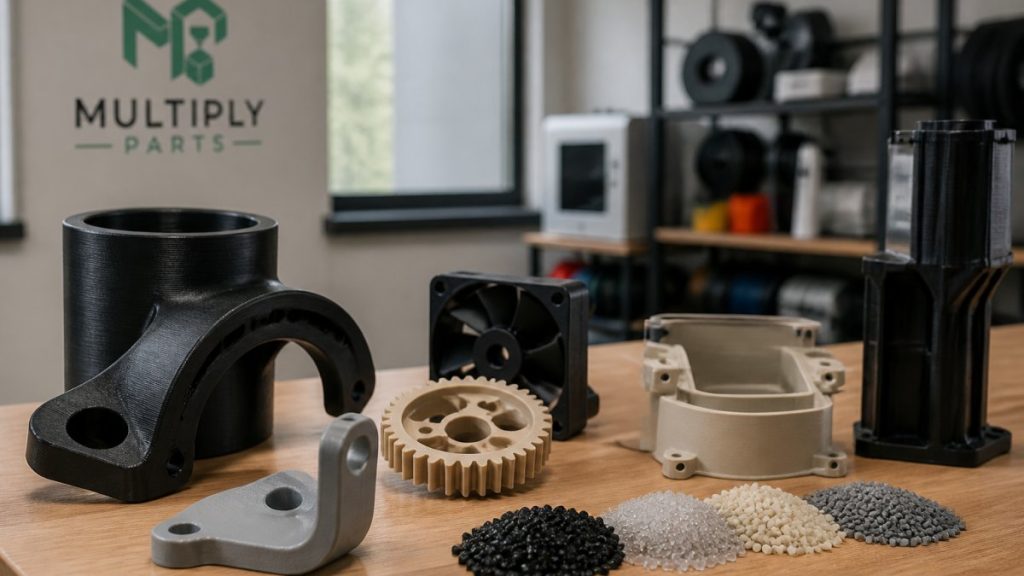
Alternatives to Standard ABS for Industrial Parts
Table of Contents
- Why Standard ABS Falls Short for Industrial Applications
- ASA vs ABS for Outdoor Durability
- PETG: Chemical Resistance and Dimensional Stability
- Polycarbonate Industrial Applications and Heat Performance
- Engineering Grade Filament Comparison
- Regulatory Compliance and Material Selection
- Choosing the Right Alternative for Your Industrial Needs
- Frequently Asked Questions
Last Updated: October 4, 2026
Why Standard ABS Falls Short for Industrial Applications
Standard ABS has long been the default choice for industrial parts, but as demands in automotive, EV, and sports equipment have intensified, alternatives to standard ABS for industrial parts have become critical to explore.
The core problem is that standard ABS wasn’t designed for the extremes modern applications demand. It yellows under UV exposure. It becomes brittle in cold conditions. It warps during cooling. It struggles with chemical exposure. For prototyping and short-run production, these aren’t minor inconveniences; they’re deal-breakers that force redesigns, delays, and scrapped batches.
This guide covers the most viable alternatives to standard ABS for industrial parts, materials that solve specific problems standard ABS can’t handle. Whether you’re dealing with outdoor exposure, chemical contact, heat stress, or impact demands, there’s a better material waiting. We’ll walk through each option, its real strengths and limitations, and how to know which one fits your application.
ASA vs ABS for Outdoor Durability
ASA (Acrylonitrile Styrene Acrylate) is essentially ABS’s tougher outdoor cousin. If your industrial parts spend time exposed to sunlight, weather, or UV radiation, ASA solves the yellowing problem that plagues standard ABS.
Mechanical properties mirror ABS, but ASA won’t degrade or discolor under prolonged sun exposure, critical for outdoor enclosures, automotive trim, and sports equipment.
ASA costs more per unit, but for short-run production, the premium is manageable and far cheaper than field failures from UV damage.
ASA works best for:
- Outdoor electrical enclosures and junction boxes
- EV charging connector housings and weather seals
- Sports equipment that endures direct sunlight (bike components, helmet ventilation covers)
- Automotive exterior trim and lighting bezels
One caveat: ASA is slightly more brittle than ABS at low temperatures. If your parts operate in cold climates, test samples before committing to full production runs.
PETG: Chemical Resistance and Dimensional Stability
PETG prioritizes chemical compatibility and dimensional accuracy over UV resistance.
PETG prints with minimal warping and excellent layer adhesion, resisting oils, solvents, weak acids, and alkalis that stress-crack standard ABS.
This extends part life in harsh chemical environments. EV battery enclosures, fluid handling components, and parts contacting oils or coolants benefit significantly.
PETG offers better impact resistance than ABS but lower stiffness, making it ideal for snap-fit assemblies, hinges, and flexing components rather than rigid structures.
Best applications for PETG:
- Chemical storage container housings
- Fluid reservoir caps and fittings
- EV cooling system components
- Industrial connector housings exposed to oils or solvents
- Mechanical assemblies requiring tight dimensional tolerances
Polycarbonate Industrial Applications and Heat Performance
Polycarbonate delivers performance standard ABS cannot match in high-temperature or extreme impact environments.
Polycarbonate maintains structural integrity at temperatures that soften standard ABS, making it essential for heat-exposed applications in electronics and automotive underbody components.
Polycarbonate absorbs impact energy without cracking and resists creep over long operational lifespans.
Polycarbonate is denser, more expensive, and requires higher processing temperatures and careful cooling, demanding more engineering attention for rapid prototyping.
Polycarbonate excels in:
- High-temperature electronic enclosures (automotive, industrial control systems)
- Impact-resistant protective covers and guards
- Transparent or translucent functional parts requiring impact resistance
- Long-term durability applications where creep resistance matters
- Automotive interior components exposed to dashboard heat
Engineering Grade Filament Comparison
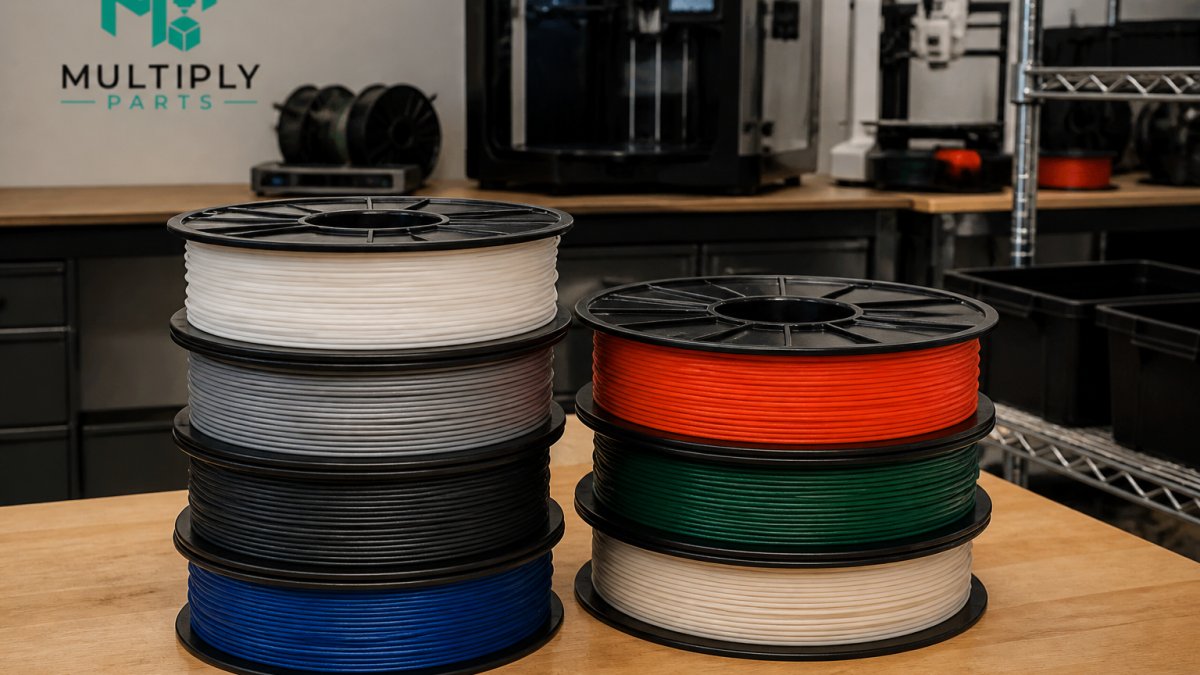
Engineering-grade materials are formulated for specific performance demands through reinforcement or specialized polymers.
Reinforced vs. Unreinforced: The Fatigue Question
Industrial parts operate under sustained or cyclic loads over months or years, where fatigue and creep behavior become critical – properties most material comparisons overlook.
Creep, gradual deformation under constant load, can cause a bracket to sag 2-3 mm after 6 months despite passing tensile tests.
Fatigue, progressive weakening under repeated stress, can cause components to crack after thousands of cycles despite passing impact tests.
Unreinforced plastics show measurable creep under sustained load; glass-reinforced materials resist creep better because fibers carry the load.
For sustained load, glass-reinforced grades resist creep and thermal cycling without carbon fiber’s brittleness. For cyclic stress, FEA and fatigue data sheets are essential.
Carbon Fiber Reinforced Materials
Carbon-reinforced materials deliver 30-40% weight savings while maintaining stiffness, ideal for EV battery brackets, drone frames, and suspension components.
Carbon-reinforced materials are brittle and prone to stress concentration failures; sharp corners can initiate sudden cracks. High-vibration environments require careful design optimization.
Carbon fiber requires higher mold temperatures, longer cooling, and precise drying; processing errors are costly given material expense.
Glass Fiber Reinforced Materials
Glass-reinforced materials offer a middle ground: stiffer than unreinforced plastics, less brittle than carbon fiber, and resistant to thermal cycling and warping.
Glass-reinforced polycarbonate is less common but valuable for applications requiring both impact resistance and stiffness.
Specialized Engineering Polymers and Long-Term Stability
PEEK, ULTEM, and high-performance nylons handle continuous high temperatures, maintain properties across wide ranges, and show minimal creep and excellent fatigue resistance.
PEEK maintains 80% strength at 250°C and shows virtually no creep, used in aerospace and medical devices.
ULTEM and polyimides cost less than PEEK and are used in electrical connectors and engine compartment components.
High-performance nylons offer excellent fatigue and creep resistance at lower cost, used in automotive suspension and transmission housings.
Choosing Between Reinforced and Unreinforced: A Decision Framework
The choice depends on your specific load case:
- Static load, room temperature: Unreinforced engineering plastics (polycarbonate, PETG) are usually sufficient.
- Sustained load or creep-sensitive application: Glass-reinforced materials are the minimum. For critical applications, move to specialized polymers.
- Cyclic or vibration stress: Fatigue data is essential. Glass-reinforced nylon or specialized polymers are safer than unreinforced grades or carbon fiber.
- High temperature + sustained load: Specialized polymers (PEEK, ULTEM) are often required. Standard engineering plastics will creep or soften.
- Weight-critical + high stress: Carbon fiber reinforced materials, but only if the design is optimized to avoid stress concentrations and the application doesn’t require high impact resistance.
Run stress analysis and consult fatigue data sheets before committing. Ask material suppliers for fatigue curves and creep data during selection.
Regulatory Compliance and Material Selection
Regulatory requirements often drive material selection more than performance. Compliance is a gate that determines usability, yet most comparisons skip it entirely.
Automotive and EV Requirements
Automotive applications require documented chemical compatibility with fuel and coolant systems. Standard ABS often fails because its resistance profile isn’t documented to automotive standards.
Electrical connectors and battery enclosures require flammability ratings under UL 94 classifications. Standard ABS typically achieves UL 94 V-2 at best; many EV applications demand V-0 or V-1 ratings, which require flame-retardant additives and higher processing temperatures. Polycarbonate and specialized engineering polymers naturally meet these thresholds, which is why they’re specified by design teams before material selection even begins.
Thermal stability thresholds are equally critical. EV battery enclosures must maintain structural integrity at temperatures that could reach 80-100°C under fault conditions. Standard ABS begins to soften around 80°C; polycarbonate holds rigidity to 130°C+. This isn’t a preference; it’s a compliance requirement written into the design specification.
Medical Device and Pathways
If your parts end up in medical equipment, material biocompatibility becomes non-negotiable. Standard ABS is rarely acceptable because it hasn’t been tested and documented for biocompatibility under Health Canada or ISO 10993 standards. Moving to a medical-grade alternative (often a specialized polycarbonate or polyetherimide) requires:
- Biocompatibility testing (cytotoxicity, sensitization, irritation)
- Material sourcing from registered suppliers
- Traceability documentation for every batch
- Often a 6-12 month regulatory approval timeline before production can begin
This isn’t a material swap; it’s a compliance project. Budget accordingly.
Consumer Product Safety Standards
Sports equipment, toys, and consumer goods fall under different regulatory umbrellas depending on the market. Impact resistance thresholds, flammability requirements, and chemical safety limits are often specified by performance rather than material name. For example, a helmet ventilation cover might require “impact energy absorption of at least 5 kJ/m² without cracking.” Standard ABS may fail this; ASA or polycarbonate typically passes.
Chemical safety regulations (like those enforced by Health Canada) restrict certain additives and require material suppliers to provide safety data sheets and compliance declarations. Engineering-grade materials usually come with this documentation; commodity ABS often doesn’t.
How to Verify Compliance Before Committing
Before you finalize a material choice:
-
Identify your regulatory landscape. Automotive? Medical? Consumer goods? Each has different gates. A few hours of research here saves weeks of rework.
-
Request compliance documentation from your material supplier. Ask specifically for:
- UL 94 flammability rating (if applicable)
- Chemical resistance test data (ASTM D543 or equivalent)
- Thermal stability data (heat deflection temperature under load)
- Biocompatibility certificates (if medical or food contact)
- Regional chemical compliance declarations
-
Run a compliance audit with your design team early. Don’t discover regulatory failures after tooling is built. Many material suppliers provide compliance checklists; use them.
-
Plan for certification timelines. Medical and automotive approvals can take months. If you’re on a tight schedule, choose a material that’s already pre-approved for your application rather than pioneering a new one.
The best material isn’t the cheapest or most advanced; it’s the one that meets your regulatory requirements and performs in your actual operating conditions. Standard ABS is still fine for many applications. But when compliance demands rise, the alternatives above are proven solutions that come with the documentation and certifications industrial buyers need.
Choosing the Right Alternative for Your Industrial Needs
Selecting the right alternative to standard ABS for industrial parts comes down to matching material properties to your actual operating conditions. The best material isn’t the most advanced or expensive; it’s the one that solves your specific problem.
Start by defining your constraints:
- Temperature range: Does the part need to handle extreme heat, cold, or thermal cycling?
- Chemical exposure: Will it contact oils, solvents, coolants, or other aggressive chemicals?
- Environmental factors: Is it exposed to UV, weather, humidity, or salt spray?
- Mechanical demands: Does it need stiffness, impact resistance, flexibility, or fatigue resistance?
- Dimensional accuracy: How tight are your tolerances?
- Cost sensitivity: Is material cost a primary driver, or is performance paramount?
Once you’ve mapped those constraints, the right material becomes clearer. ASA solves outdoor UV problems. PETG handles chemical exposure and tight tolerances. Polycarbonate delivers heat and impact performance. Engineering grades handle extreme structural demands.
For rapid prototyping and short-run production, MultiplyParts supports a diverse range of advanced materials. With no minimum order quantities and instant pricing, you can test materials without committing to large batches. Validate performance in real conditions, then scale with confidence.
The goal isn’t to find the perfect material; it’s to find the right one for your specific job. Standard ABS is still fine for many applications. But when it falls short, the alternatives above are proven solutions that engineers and manufacturers rely on daily.
| Material | Best For | Key Strength | Key Limitation |
|---|---|---|---|
| ASA | Outdoor exposure | UV stability | Higher cost than ABS |
| PETG | Chemical resistance | Dimensional accuracy | Lower stiffness than ABS |
| Polycarbonate | Heat and impact | Thermal stability | Denser, more expensive |
| Carbon Fiber Reinforced | Structural load | High stiffness-to-weight | Brittleness risk |
| Glass Fiber Reinforced | Rigid structures | Good thermal cycling | Moderate cost premium |
Frequently Asked Questions
Why is ABS often replaced in industrial manufacturing?
Standard ABS has limited UV resistance, tends to yellow and degrade outdoors, and can warp during cooling. For industrial parts exposed to sunlight, temperature fluctuations, or chemical environments, alternatives like ASA and PETG offer superior dimensional stability, better chemical resistance, and longer functional life. Engineers also choose alternatives when parts require higher impact strength or thermal performance than standard ABS can deliver.
What are the best high-temperature alternatives to ABS?
PC-ABS (polycarbonate-ABS alloy) and polycarbonate-based materials excel in high-temperature applications, maintaining structural integrity under sustained heat loads. For moderate heat resistance with better processability, PETG offers a balanced middle ground. Engineering-grade thermoplastics like nylon-based compounds and carbon-fiber reinforced variants also provide superior heat deflection temperature compared to standard ABS, making them ideal for automotive and EV battery enclosures.
How do I know which alternative material will work for my specific application?
Start by identifying your part’s primary stress: UV exposure, chemical contact, impact, or heat. Review the material’s tensile strength, impact resistance, and heat deflection temperature against your design requirements. MultiplyParts offers technical support to validate material selection before you commit to production, ensuring your choice meets performance and longevity standards.
Are alternatives to ABS more expensive?
Material costs vary by alternative and production volume. ASA typically costs slightly more than standard ABS but delivers superior UV resistance, reducing long-term replacement costs. PETG is often competitively priced while offering better chemical resistance. PC-ABS and engineering-grade filaments command higher material costs but eliminate the need for secondary materials or frequent part replacement. For rapid prototyping and short-run production with no minimum order quantities, instant pricing from MultiplyParts lets you compare costs across materials before deciding.
Choosing the right material for industrial parts isn’t guesswork. It’s about matching engineering requirements to material capabilities. When standard ABS stops delivering, the alternatives covered here have proven track records across automotive, EV, sports, and manufacturing sectors. Get an instant quote from MultiplyParts and test your preferred material at scale with zero minimum order commitments.
