

PEEK vs PEKK Properties for Manufacturing: 2026 Comparison
Table of Contents
- PEEK vs PEKK Properties at a Glance
- Material Definitions and Polymer Structure
- Mechanical Strength, Stiffness, and Thermal Performance
- Crystallization Rate, Crystallinity, and Chemical Resistance
- PEEK vs PEKK 3D Printing: Printability and Processing Windows
- PEKK Filament Properties and Interlayer Adhesion
- PEEK and PEKK Applications: A Selection Framework
- Manufacturing Routes, Cost, and Long-Term Durability
- Frequently Asked Questions
Last Updated: October 20, 2026
PEEK vs PEKK Properties at a Glance
PEEK vs PEKK comes down to one trade-off: PEEK delivers higher crystallinity and peak mechanical performance, while PEKK offers a slower crystallization rate that makes it easier to process. At MultiplyParts, we field this question often from designers weighing high-temperature materials for EV and sports components.
PEKK is a polyetherketoneketone, a semicrystalline high-performance thermoplastic in the PAEK family. PEEK, or polyetheretherketone, is its better-known relative. Both handle heat and chemicals well. They diverge in how they behave during processing, and that is where material selection actually gets decided.
Side-by-Side Property Comparison
| Property | PEEK | PEKK |
|---|---|---|
| Polymer family | PAEK, semicrystalline | PAEK, semicrystalline |
| Crystallization rate | Faster | Slower |
| Processing difficulty | More demanding | More forgiving |
| Heat resistance | High | High |
| Chemical resistance | Strong | Strong, with reported fluid resistance |
| Dielectric stability | Good | Reported as good |
| Best fit | Peak mechanical and thermal demand | Processability-sensitive builds |
The table above summarizes the practical split. The sections below explain what each row means on the shop floor.
Material Definitions and Polymer Structure
Both materials belong to the PAEK family, a group of high-performance thermoplastics built on an aromatic backbone. That structure is why they resist heat and chemicals where commodity plastics fail. PEEK is a homopolymer with a repeating ether-ketone-ether sequence.
That copolymer flexibility matters. As Roboze’s technical comparison of PEEK and PEKK notes, PEEK’s high crystallinity underpins its mechanical, chemical, and thermal performance.
Mechanical Strength, Stiffness, and Thermal Performance
PEEK generally leads on raw mechanical and thermal performance, but the gap is narrower than marketing copy suggests and depends heavily on grade, crystallinity, and test method.
| Property | Unfilled PEEK (typical range) | Unfilled PEKK (typical range) | Test condition to confirm |
|---|---|---|---|
| Tensile strength | ~90-100 MPa | ~85-100 MPa | ISO 527, 23 °C |
| Tensile modulus | ~3.5-4.0 GPa | ~3.5-4.5 GPa | ISO 527, 1 mm/min |
| Elongation at break | ~20-40% | ~5-20% (grade dependent) | ISO 527 |
| Glass transition (Tg) | ~143 °C | ~155-165 °C | DSC or DMA |
| Melting temperature (Tm) | ~343 °C | ~300-380 °C (copolymer ratio dependent) | DSC |
| Heat deflection temperature (HDT) | ~150-160 °C unfilled; 300 °C+ with CF | ~150-160 °C unfilled; 300 °C+ with CF | ISO 75, 1.8 MPa |
| Crystallinity (as-molded) | ~30-35% | ~20-30% (process dependent) | DSC |
Three practical readings of that table:
- Stiffness and strength are close in unfilled grades. PEEK’s edge shows up more in reinforced grades and in parts where full crystallinity is achieved. A poorly crystallized PEEK part can underperform a well-processed PEKK part.
- PEKK’s higher Tg is a real advantage for parts that must hold modulus above 150 °C, even though PEEK’s higher Tm gets more attention. Tg governs service temperature; Tm governs processing.
- Elongation is the sleeper spec. PEEK’s higher ductility matters for snap-fits, press-fits, and parts that see impact. PEKK’s lower elongation in some grades favors stiffness-critical geometry but demands more careful design around stress concentrators.
For design work, treat PEEK as the benchmark when a part must carry load at temperature and survive impact. Treat PEKK as the pragmatic choice when the geometry is complex, the service temperature sits between 150 °C and 250 °C, and you need consistent crystallinity from the printer.
PEEK vs PEKK Heat Resistance
PEEK vs PEKK heat resistance is closer than most buyers expect, and the useful comparison is not melting point but the combination of Tg, HDT, and continuous-use temperature. PEEK’s Tg sits around 143 °C and its Tm around 343 °C.
That means PEKK can hold stiffness to a higher service temperature in some grades, while PEEK offers a wider processing window at the top end and a longer track record in continuous-use data.
Crystallization Rate, Crystallinity, and Chemical Resistance
Crystallization rate is the property that separates these materials in production. PEEK crystallizes quickly, which supports high crystallinity and strong chemical resistance, but punishes uneven cooling. Slow it too much or cool it unevenly and you get warping and weak layers.
Chemical resistance follows crystallinity. PEEK’s ordered structure resists solvents and aggressive fluids well. PEKK is reported to have strong resistance to chemical fluids plus good dielectric stability, a useful combination for electrical housings and connectors.
On thick PEKK parts, slow the cooling further than the datasheet suggests. The slower crystallization rate buys you tolerance, but thick sections still hold heat unevenly, and that is where warping starts.
PEEK vs PEKK 3D Printing: Printability and Processing Windows
PEEK vs PEKK 3D printing favors PEKK on processability. PEEK needs a heated chamber, high nozzle temperatures, and controlled cooling to crystallize properly.
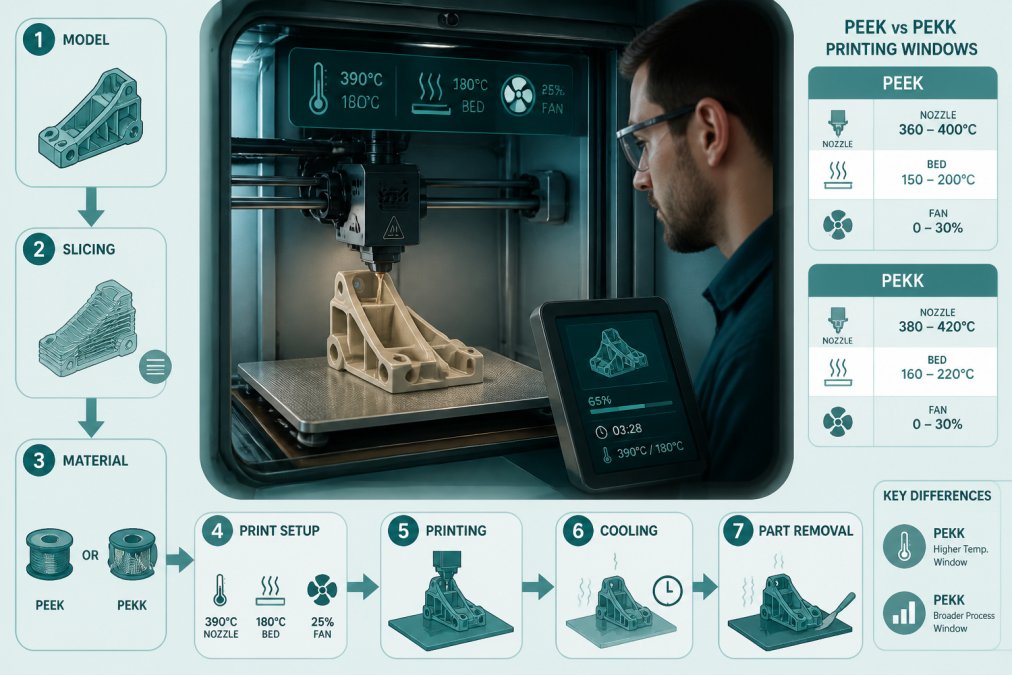
Neither material is a plug-and-play filament. Both require a printer rated for high-temperature polymers, and both punish shortcuts in chamber control. The difference is margin for error.
AON3D’s PEEK material properties and applications guide frames PEKK as PEEK’s closest relative and highlights PEEK’s thermal and mechanical edge, which matches what we see: PEEK for performance, PEKK for process tolerance.
PEKK Filament Properties and Interlayer Adhesion
PEKK filament properties matter most at the layer lines. Interlayer adhesion is the weak point in any high-temperature print, because the bond between layers depends on the previous layer staying hot enough to fuse.
PEKK’s slower crystallization keeps the interface workable longer, which generally supports stronger interlayer bonding and less warping. That does not make PEKK immune to layer issues. It means the material gives the process more time to do its job.
Printing PEEK on a machine without active chamber heating is the most common mistake we see. The part may look fine off the bed, then crack along layer lines under load. Crystallinity never developed, and the failure shows up in service, not in the print.
PEEK and PEKK Applications: A Selection Framework
PEEK and PEKK applications split along a clear line: performance-critical parts go to PEEK, process-sensitive builds go to PEKK. Use this framework to decide.
- Does the part carry structural load at temperature? If yes, PEEK is the default.
- Is the geometry complex or thick-sectioned? If yes, PEKK’s slower crystallization reduces warping risk.
- Does the part face aggressive fluids or need dielectric stability? PEKK is reported strong on both; PEEK resists solvents well.
- Does your printer have a high-temperature chamber? If not, neither material is a fit until you upgrade.
- Is production volume scaling? Consistency across batches favors the material with the wider processing window.
MultiplyParts specializes in high-performance materials for sports and EV components, and we run this framework with designers before quoting. Our instant pricing and no-minimum-order model lets you validate a material choice on a small run before committing to production.
Manufacturing Routes, Cost, and Long-Term Durability
Most public comparisons stop at 3D printing. That is a gap worth closing, because the route you choose changes the property profile you actually get, not just the unit cost. PEEK and PEKK are both injection moldable, machinable, and printable, and each route has a distinct economics and quality story.
Route-by-route comparison
| Route | Best fit | Key process considerations | Cost drivers |
|---|---|---|---|
| Fused filament 3D printing | Prototypes, short runs, lattices, replacement parts | Heated chamber (typically 150-200 °C for PEEK), nozzle ~400-450 °C, controlled cooling to develop crystallinity | Resin price per kg, machine time, scrap rate from failed builds |
| Injection molding | Volumes where tooling amortizes, simple-to-moderate geometry | Melt temps near 360-400 °C, hot-runner design, mold temperatures ~180-200 °C, anneal cycle for crystallinity | Tooling (steel, high-temp heaters), cycle time, scrap and regrind policy |
| CNC machining | One-offs, tight-tolerance features, large parts | Stock shapes (rod, plate) must be annealed before machining to relieve stress; sharp tooling and coolant control | Stock cost, machining time, material use |
A few practical patterns manufacturers run into:
- Printing avoids tooling but carries the highest per-part resin cost and the most process sensitivity. Crystallinity control is the quality lever; chamber temperature uniformity matters more than nozzle temperature.
- Molding wins on unit cost once volume justifies tooling, but PEEK and PEKK both demand hot runners and mold temperatures that many general-purpose molders are not equipped for. Cycle times are longer than commodity resins because of the high mold temperature and anneal requirements.
- Machining is often the fastest route to a functional part, but residual stress in extruded stock causes distortion after material removal unless the blank is annealed first. PEKK’s slower crystallization can make stress relief more forgiving, while PEEK’s higher crystallinity rewards a disciplined anneal schedule.
Total cost and production economics
Resin price is only one line. A realistic comparison includes:
- Material cost per part, driven by resin price, buy-to-fly ratio in machining, and scrap rate in printing.
- Equipment investment, a high-temperature printer with an active heated chamber is a different capital class from a standard FDM machine; a molding cell needs high-temp tooling and dryers.
- Cycle time and labor, printing is largely unattended but slow per part; molding is fast per part but needs setup and process validation; machining is labor-heavy per part.
- Post-processing, annealing, stress relief, surface finishing, and inspection all add cost, and crystallinity verification (DSC or density) is often required for regulated parts.
- Scrap and rework, PEKK’s wider processing window typically lowers print scrap, which can offset a higher resin price at scale.
We quote in CAD and price per project based on quantity, geometry, material, and route, so the comparison stays honest rather than anchored to a single resin number.
Long-term performance and durability
Short-term datasheets hide the differences that decide service life. The practical comparison:
- Fatigue, both materials perform well in cyclic loading, but PEEK has the deeper published fatigue data set, which matters for safety-critical certification.
- Creep, PEKK’s higher Tg can give it an edge in sustained load above 150 °C; below that, grade and crystallinity dominate.
- Aging and moisture, both absorb some moisture at elevated temperature; drying before processing is mandatory for both, and hydrolysis resistance is a function of grade and crystallinity, not just polymer family.
- Sterilization, both tolerate steam, gamma, and EtO cycles in the grades formulated for medical use; confirm the specific grade’s validation data rather than assuming family-level performance.
- Chemical exposure, PEEK’s higher crystallinity generally gives it the edge in aggressive solvent and fuel exposure; PEKK’s reported fluid resistance is strong but grade-specific.
PEKK’s processability edge pays off in fewer rejected parts, which is its own form of durability. PEEK’s higher crystallinity gives it the edge in sustained chemical and thermal exposure. The right answer depends on whether your risk sits in the process or in the service environment.
Frequently Asked Questions
Is PEEK stronger than PEKK?
Neither wins across every measure. PEEK’s higher crystallinity is associated with strong mechanical, chemical, and thermal performance, so it is often the default for load-bearing parts. PEKK’s slower crystallization gives it better processability and reported resistance to chemical fluids plus dielectric stability. The right choice depends on whether your priority is peak mechanical performance or a more forgiving process window.
Which is easier to 3D print, PEEK or PEKK?
PEKK is generally described as easier to process for additive manufacturing. Its slower crystallization rate gives the part more time to bond between layers before it solidifies, which helps with interlayer adhesion and reduces warping. PEEK needs stricter conditions, including a higher chamber temperature and slower cooling, so it demands more capable hardware and tighter process control.
How do PEEK and PEKK compare in heat resistance?
Both are high-performance semicrystalline polymers in the PAEK family and both hold up in high-temperature environments. PEEK is typically cited as the benchmark for thermal and mechanical performance relative to PEKK. PEKK still delivers strong heat resistance and its slower crystallization can support better layer bonding. Confirm the specific grade’s datasheet for the service temperature your application requires.
When should manufacturers choose PEKK over PEEK?
Choose PEKK when processability matters as much as performance. Its slower crystallization rate makes it more forgiving on industrial printers, and it is reported to have better resistance to chemical fluids and good dielectric stability. That suits parts exposed to aggressive fluids or electrical environments. If your application is purely mechanical and your process can hold PEEK’s demanding conditions, PEEK remains the reference point.
Are PEEK and PEKK suitable for functional 3D-printed parts?
Yes. Both are high-performance thermoplastics used for functional parts, not just prototypes. PEEK’s high crystallinity supports mechanical, chemical, and thermal performance. PEKK offers a slower crystallization rate plus reported chemical-fluid resistance and dielectric stability, which helps with interlayer adhesion and warping. For production runs, work with a partner that controls chamber temperature and cooling, since both materials punish loose process control.
Material choice between PEEK and PEKK is really a question about your process, not just your part. If you are weighing high-temperature materials for an EV or sports component and want a partner who will validate the fit before you commit, MultiplyParts offers instant pricing, no minimum order quantities, and a material range built for exactly this decision. Get an instant quote and put your CAD file in front of a real production team.
