

What Does Industrial 3D Printing Material Cost Per Kg?
Last Updated: October 28, 2026
Quick Summary
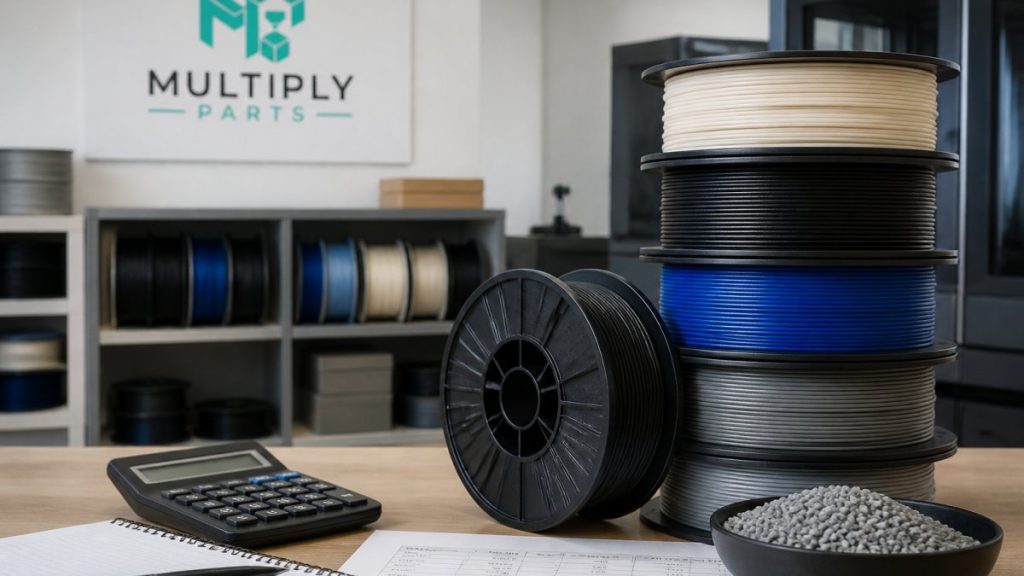
The 3D printing material cost per kg ranges from $25-$45 for standard PLA, ABS, and PETG, $60-$120 for reinforced carbon fiber and glass-filled grades, and $90-$400+ for engineering polymers such as PA, PEEK, and PEI. Grade, spool size, order volume, and supply chain all move that per-kg number.
- Unit price falls as spool size rises, so 5 kg and 10 kg spools beat 1 kg spools on cost per gram.
- Divide per-kg price by success rate: a $30/kg spool at 80% success costs about $37.50 per good kilogram.
- Carbon fiber filament abrades brass nozzles quickly, so budget for hardened or ruby nozzles as a consumable cost.
- Resin is sold by volume while filament is sold by weight, which makes direct cost comparison tricky.
- PEEK and PEI require 350°C+ nozzles and chambers holding 200°C+, so per-kg cost understates true cost.
Table of Contents
- What Drives the Cost of Industrial 3D Printing Materials Per Kg
- Industrial 3D Printing Material Price Comparison: Standard vs Engineering-Grade
- Cost of Carbon Fiber Reinforced Filament and Other High-Performance Options
- Resin vs Filament: How Material Costs Differ
- Using a 3D Printing Material Cost Calculator to Price a Part
- Hidden Costs That Sit Outside the Per-Kg Price
- Get an Instant Quote for Your Industrial 3D Printing Project
- Frequently Asked Questions
What Drives the Cost of Industrial 3D Printing Materials Per Kg
The 3D printing material cost starts with the polymer itself, then climbs through grade, spool format, and supply chain before it ever reaches your print bed. Buyers who understand what moves the per-kg number can make more informed material decisions than buyers who chase the lowest headline price. Below, we break down the real drivers, compare standard and engineering tiers, and show how to calculate a true part cost rather than a misleading filament price.
Polymer Type and Grade
Polymer chemistry sets the floor price. Commodity thermoplastics such as PLA sit at the bottom because they are produced at enormous volume for consumer markets. Engineering polymers such as PA, PEEK, and PEI cost more because they are synthesized in smaller batches, require tighter process control, and often demand heated chambers and higher nozzle temperatures during printing.
Grade matters as much as chemistry. A general-purpose ABS and a flame-retardant, impact-modified ABS are the same base polymer but not the same product. Additives, certifications, and batch consistency testing all carry a premium.
Watch out: buying an engineering-grade polymer without confirming your printer can hold the required chamber temperature wastes the entire spool. The material will print, but layer adhesion and dimensional stability will not match the datasheet.
Spool Size, Order Volume, and Supply Chain
Unit price falls as spool size rises. A 1 kg spool carries more packaging, handling, and freight cost per kilogram than a 5 kg or 10 kg spool, so the larger format almost always wins on cost per gram.
Order volume compounds the effect. Industrial buyers purchasing pallet quantities negotiate better terms than buyers ordering single spools, and the gap widens for imported specialty polymers where freight and duties are a larger share of landed cost.
Supply chain is the third lever. Domestic stock reduces lead time and currency exposure; imported material can be cheaper on paper but carries freight, brokerage, and exchange-rate risk. For Canadian buyers, landed cost is the number that matters, not the listed price on a foreign distributor’s page.
Industrial 3D Printing Material Price Comparison: Standard vs Engineering-Grade
Standard thermoplastics and engineering polymers occupy different cost bands, and the gap is driven by chemistry, processing requirements, and certification.
| Tier | Typical Materials | Typical Price Band (CAD/kg) | Best For |
|---|---|---|---|
| Standard | PLA, ABS, PETG | $25-$45 | Prototypes, visual models, jigs |
| Reinforced | Carbon fiber, glass-filled | $60-$120 | Stiff structural brackets |
| Engineering | PA, PEEK, PEI | $90-$400+ | Heat-exposed, load-bearing parts |
PLA, ABS, and PETG: The Standard Tier
PLA is the cheapest and easiest to print, typically landing in the low end of the standard band. It offers good stiffness and detail but low heat resistance, parts soften well below the temperatures a car interior reaches on a summer day. ABS sits modestly higher: better toughness and temperature tolerance, but it warps without an enclosure and benefits from a heated chamber. PETG sits between them in both price and performance, tougher than PLA, easier than ABS, and a sensible default for functional parts that see moderate load.
A practical rule: if the part will live indoors and see no load, PLA’s price advantage is real; if it will see sun, heat, or impact, the ABS or PETG premium is usually cheaper than reprinting in PLA.
PA, PEEK, and PEI: The Engineering Tier
Nylon (PA) brings wear resistance and flexibility, and glass- or carbon-filled variants push stiffness higher. PEEK and PEI are the top of the range: high continuous service temperatures, excellent chemical resistance, and a price to match, often several times the cost of a standard spool. Both require hot chambers and careful drying, so the per-kg cost understates the true cost of using them.
That understatement is the point most buyers miss. A PEEK spool that costs four times a PLA spool also demands a printer capable of 350°C+ nozzle temperatures and a chamber that holds 200°C+, plus a drying regimen that consumes time and equipment. If your machine cannot hold those conditions, the material will print but layer adhesion and dimensional stability will not match the datasheet, and the entire spool is wasted. Engineering-tier pricing only makes sense when the application genuinely needs the heat or chemical resistance.
Price bands are a starting point, not a quote. The real comparison is cost per acceptable part, a $30/kg spool that fails one print in five costs more per good part than a $40/kg spool that prints reliably.
Cost of Carbon Fiber Reinforced Filament and Other High-Performance Options
Carbon fiber reinforced filament is a chopped-fiber composite that trades ductility for stiffness, and it commands a clear premium over the base polymer it is built on. The fiber content, base resin, and whether the material is short-fiber or continuous-fiber all move the price.
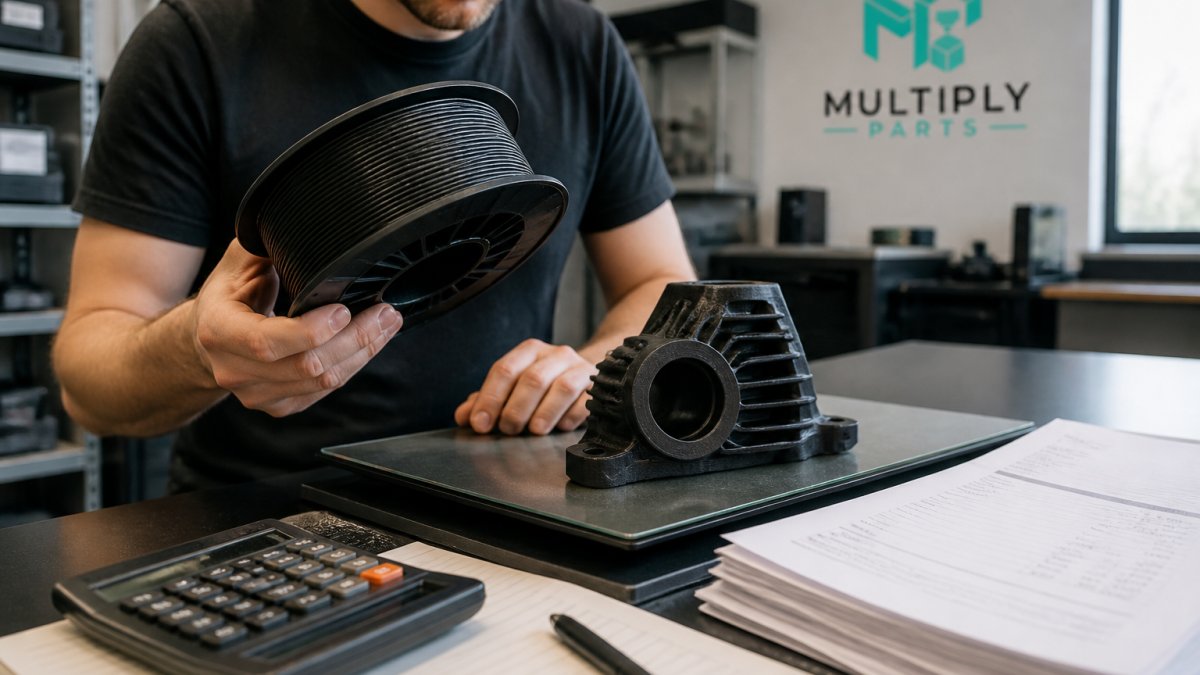
Chopped-fiber grades are the practical middle ground: stiffer than unfilled polymer, printable on hardened nozzles, and priced between standard and engineering tiers. Continuous-fiber reinforcement jumps into a different cost class entirely because the deposition hardware is specialized.
Watch out: carbon fiber filament abrades brass nozzles quickly. Budget for hardened or ruby nozzles as a consumable cost, or the nozzle replacement bill will quietly erode your material savings.
Resin vs Filament: How Material Costs Differ
Resin and filament are priced on different bases, which makes direct comparison tricky. Filament is sold by weight on a spool; resin is sold by volume in bottles, and the density difference means a kilogram of resin occupies less volume than a kilogram of filament.
SLA resin generally costs more per kilogram than standard FDM filament but delivers finer detail and smoother surfaces straight off the platform. FDM wins on cost per part for larger, simpler geometries; SLA wins when surface finish and small feature resolution matter more than material spend.
Consumables differ too. Resin printing requires IPA for washing, gloves, and replacement tanks and films. FDM consumes nozzles, build plates, and occasionally PTFE tubing. Both carry electricity costs, but resin’s post-processing consumables tend to add more per part.
Using a 3D Printing Material Cost Calculator to Price a Part
A material cost calculator converts geometry and settings into a dollar figure, and the formula is simpler than most buyers expect. The core calculation is volume multiplied by density to get mass, then mass multiplied by cost per gram, adjusted for infill and support waste.
Material cost = (part volume × density × infill factor + support volume) × cost per gram
The Variables That Change the Number
- Infill percentage: 20% infill uses a fraction of the material of a solid part; structural parts need more.
- Layer height: finer layers increase print time and electricity consumption without changing material mass much.
- Support structures: overhangs consume material that is discarded after printing.
- Print failure rate: a failed print wastes the full material load, not just the defective portion.
- Slicer software settings: wall count and top/bottom layers drive mass more than infill in many designs.
Hidden Costs That Sit Outside the Per-Kg Price
The per-kg price is the visible cost; the total cost of ownership is what actually hits your budget. Most guides stop at the filament invoice. The sections below go further, because the gap between the two numbers is where material decisions are won or lost.
The Cost of Failure
Every failed print consumes material, machine time, and operator attention, and the material loss is the full load, not just the defective portion. A print that fails at 80% completion has already consumed roughly 80% of its material, and that material cannot be recovered. If a cheaper spool fails one print in five while a slightly more expensive spool fails one in twenty, the cheaper spool’s effective cost per good part is higher, not lower.
A simple way to model it: divide the per-kg price by the success rate. A $30/kg spool at an 80% success rate costs about $37.50 per kilogram of good output; a $40/kg spool at a 95% success rate costs about $42 per kilogram of good output. The gap narrows sharply, and once you add the labor and machine time lost to each failure, the reliable spool usually wins. Most practitioners find that reliability premiums pay for themselves once a print runs longer than a few hours.
Post-Processing Consumables
Post-processing is the second omission. Support removal, sanding, vapor smoothing, dyeing, and painting all consume labor and consumables that never appear on a filament invoice. For FDM parts, that means sandpaper, filler primer, and sometimes acetone or a dedicated smoothing solvent. For resin parts, it means IPA for washing, gloves, replacement tanks, and films, and those consumables add up per part faster than most buyers expect, especially on small parts where the wash volume is fixed but the part volume is tiny.
Electricity and Machine Wear
Electricity and maintenance round out the picture. High-temperature polymers demand heated chambers and long print times, both of which draw power. Nozzle, build plate, and hotend wear accelerate with abrasive materials, carbon fiber filament abrades brass nozzles quickly, so hardened or ruby nozzles become a consumable cost that quietly erodes material savings. Budget for those replacements as a per-kilogram overhead rather than a surprise.
Sustainability and Recycled Material
Sustainability is entering the calculation too. Recycled and regrind filament options are appearing in more catalogs, and buyers with procurement targets are starting to weigh them against virgin material on both price and reporting. The premium for recycled stock varies widely by supplier and grade, so the practical approach is to request the recycled option’s price alongside the virgin price and compare on cost per acceptable part, not headline per-kg.
The hidden costs above are not hypothetical. A material that prints reliably at a slightly higher per-kg price often beats a cheaper spool once failure rate, post-processing, and machine wear are counted. Build those three numbers into your comparison before you commit to a bulk order.
Get an Instant Quote for Your Industrial 3D Printing Project
Working out the cost of industrial 3D printing materials per kg is the first step; turning that into a priced, production-ready part is the next. MultiplyParts offers instant pricing and no minimum order quantities. Get started with MultiplyParts and price your next part today.
Frequently Asked Questions
How much does 1kg of industrial-grade 3D printing material cost in CAD?
Pricing depends on the material and other order details. Check MultiplyParts’ website for current pricing or a quote.
What factors influence the price per kg of high-performance polymers?
Pricing depends on the material and order details. Check MultiplyParts’ website for current pricing or a quote.
Is there a significant price difference between standard and industrial 3D printing materials?
Material suitability depends on the part’s requirements. Check MultiplyParts’ website for current pricing or a quote.
How do material costs impact the total price of a 3D printed part?
Pricing depends on the part and order details. Check MultiplyParts’ website for current pricing or a quote.

