
7 Rapid Prototyping Examples That Cut Development Time
Last Updated: October 30, 2026
Quick Summary
Rapid prototyping examples include EV battery enclosure brackets, hockey stick blade inserts, bike rack components, robot gripper jaws, wearable sensor housings, consumer product enclosures and software interface mockups. Each example answers a specific engineering question before money is committed to tooling, using additive, subtractive or formative methods. The pattern across all seven is to prototype the riskiest unknown first, in the process that answers that specific question.
- Additive methods build layer by layer, subtractive methods cut from solid stock, and formative methods shape material with a mold or tool.
- A blade printed in the wrong orientation delaminates at the layer boundary before it reveals anything about the design.
- Prototype the geometry of a wearable housing additively, then move to cast urethane for sealing and surface-feel checks.
- Do not cut tooling until the design has stopped changing, because changes after tooling are expensive.
- A failed prototype is a successful test, so test functional prototypes to failure rather than to pass.
Table of Contents
- What Rapid Prototyping Examples Teach You About Faster Product Development
- Rapid Prototyping Methods Behind the Most Useful Examples
- 7 Rapid Prototyping Examples Across Industries
- Functional Prototype Examples That Survive Real Testing
- Rapid Prototyping Materials and How to Match Them to the Job
- Rapid Prototyping vs 3D Printing: Where the Two Diverge
- Get Your First Prototype Quoted and Built
- Frequently Asked Questions
What Rapid Prototyping Examples Teach You About Faster Product Development
The most useful rapid prototyping examples share one trait: each answers a specific engineering question before money gets committed to tooling.
Below, we break down seven rapid prototyping examples across industries, the rapid prototyping methods behind them, and where each approach earns its keep. A useful pattern is to prototype the riskiest unknown first.
Rapid Prototyping Methods Behind the Most Useful Examples
Every example runs on one of three process families, and picking the wrong family wastes more time than picking the wrong material. Additive methods build parts layer by layer. Subtractive methods cut material away. Formative methods shape material with a tool.
Additive, Subtractive, and Formative Approaches Compared
| Approach | How It Works | Best For | Main Trade-off |
|---|---|---|---|
| Additive | Builds layer by layer from a 3D model | Complex geometry, low volume, fast iteration | Surface finish needs work on some processes |
| Subtractive | Cuts from solid stock, usually CNC machining | Tight tolerances, strong isotropic parts | Setup cost per design change |
| Formative | Forms material with a mold or tool | Validating the final production process | Tooling lead time upfront |
If you are weighing the additive routes specifically, our breakdown of FDM, SLS, and SLA for functional prototypes covers strength, detail and surface quality side by side.
7 Rapid Prototyping Examples Across Industries
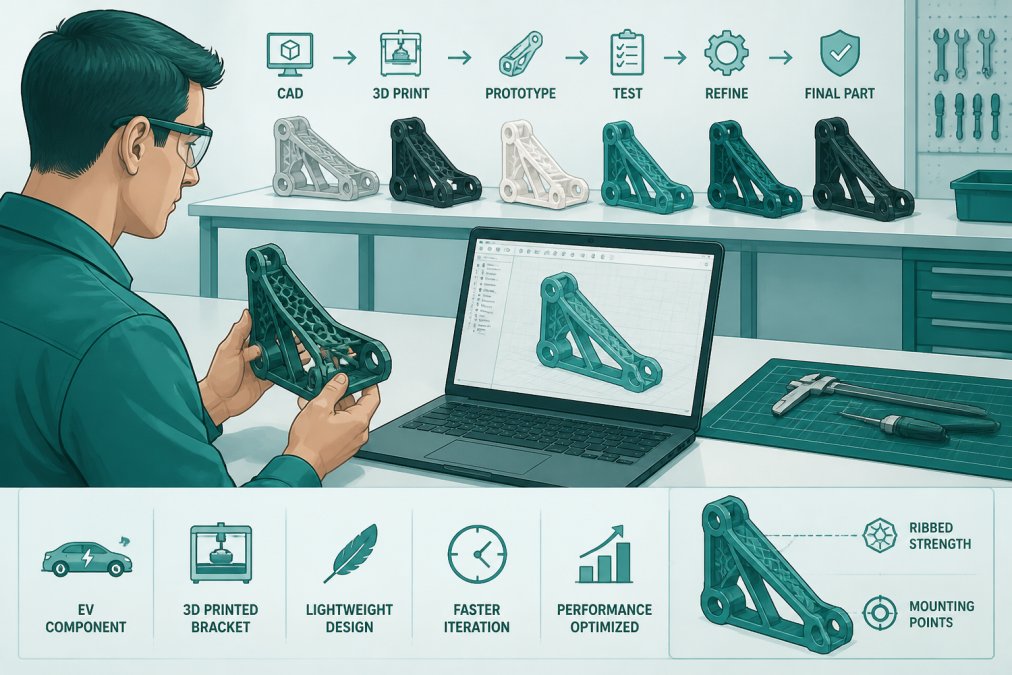
The examples below are mapped to the development stage each serves, the process a team might choose, and the trade-off that decides whether the prototype is worth building.
| Example | Development stage | Process we would choose | Fidelity driver | Main limitation to plan for |
|---|---|---|---|---|
| EV battery enclosure bracket | Fit check and thermal validation | Additive (SLS or FDM) for fit; CNC for load | Bolt pattern accuracy, heat resistance | Printed polymers under-represent metal stiffness; validate thread strength separately |
| Custom hockey stick blade insert | Functional impact testing | Additive, oriented for impact | Layer orientation and wall thickness | Delamination at layer boundaries; test to failure, not to pass |
| Bike mount and hitch rack component | Load and vibration testing | Short-run additive, or CNC for high-load variants | Dynamic load survival | Surface finish and creep under sustained load differ from molded production parts |
| Robot end-effector gripper jaw | Geometry iteration | Additive | Iteration speed and complex geometry | Wear surfaces and grip compliance differ from production elastomer or machined jaw |
| Wearable sensor housing | Sealing and ergonomic checks | Additive plus formative (cast urethane) | Sealing geometry and surface feel | Print layer lines can leak; sealing checks need post-processing or a cast sample |
| Consumer product enclosure | Production-representative samples | Formative tooling (rapid tooling) | Cosmetic finish and production material behavior | Tooling lead time and cost upfront; changes after tooling are expensive |
| Software interface prototype | Usability validation before hardware | Digital (interactive mockup) | Speed of iteration | Does not validate physical ergonomics, drop, or thermal behavior |
EV Battery Enclosure Bracket
An EV battery enclosure bracket holds pack structure in place while managing heat and vibration. Prototype it early in additive or machined form to confirm bolt patterns and clearance before committing to production tooling. Material choice decides whether the test is meaningful; our guide to the best industrial 3D printing materials for EV parts covers heat and strength options for exactly this bracket.
Custom Hockey Stick Blade Insert
A blade insert is a replaceable section bonded into a stick blade to tune stiffness and feel. Players notice the difference immediately, which makes it a perfect functional prototype: cheap to iterate, brutal to test. The limitation is layer orientation, a blade printed in the wrong orientation delaminates at the layer boundary before it reveals anything about the design, so the test tells you about the print, not the part. Our guidance on designing 3D printed parts for high-impact sports covers the wall thickness and orientation decisions that keep a blade from delaminating.
Bike Mount and Hitch Rack Component
A hitch rack component carries dynamic load, so the prototype must survive vibration and shock, not just static weight. This is where short-run additive production genuinely competes with tooling, because volumes are low and design changes frequent. The trade-off is creep and surface finish: a printed part that passes a short vibration test can still relax under sustained load in a way a molded or machined part will not.
Robot End-Effector Gripper Jaw
A gripper jaw is the contact surface of a robot end effector and usually the part that changes most often as a cell is tuned. Prototype it additively because the geometry is complex and the iteration count is high. The limitation is wear and compliance: a printed jaw grips differently from a production jaw in machined aluminum or molded elastomer, so use the prototype to settle geometry and reserve material decisions for a second build.
Wearable Sensor Housing
A wearable housing has to seal, fit a body contour, and survive daily handling. Prototype the geometry additively, then move to cast urethane or a formative process for sealing and surface-feel checks. Print layer lines can leak, so a sealing test on a raw printed housing can fail for reasons that have nothing to do with the design.
Consumer Product Enclosure
An enclosure is where formative tooling earns its keep. Once the design is stable, rapid tooling produces samples in the production material with the production finish, which is what user testing and regulatory review need. The limitation is upfront cost and lead time, and the rule is simple: do not cut tooling until the design has stopped changing.
Software Interface Prototype
Not every rapid prototype is physical. An interactive interface mockup validates usability before hardware exists and is the cheapest iteration in the list. It cannot validate physical ergonomics, drop, or thermal behavior, so treat it as a concept-stage tool and plan a physical build for the questions it cannot answer.
The pattern across all seven: prototype the riskiest unknown first, in the process that answers that specific question.
Functional Prototype Examples That Survive Real Testing
A functional prototype performs the job, not just looks like it. The distinction matters because cosmetic models pass reviews and fail tests.
What most guides miss is that a failed prototype is a successful test, and that some functional prototypes mislead even when they pass.
| Functional prototype example | What it validates | Where it can mislead |
|---|---|---|
| EV bracket under vibration and thermal cycling | Mounting integrity and heat tolerance | Printed polymer passes vibration but under-represents metal stiffness and thread pull-out |
| Hockey blade insert under repeated impact | Impact toughness and layer bonding | Passes at room temperature but fails in cold, where many polymers embrittle |
| Hitch rack component under dynamic load | Shock and fatigue survival | Short test passes, but creep under sustained load shows up only over weeks |
| Gripper jaw under repeated grip cycles | Geometry and contact fit | Printed jaw wears faster than the production material, so cycle life is not representative |
| Wearable housing under water ingress | Sealing geometry | Raw printed surfaces leak at layer lines; the design may be fine and the process wrong |
| Enclosure under drop and assembly | Production-material behavior and fit | Cast urethane approximates but does not match molded shrinkage and finish |
Three mechanisms explain most misleading results. First, material-property differences: a printed part is often anisotropic, so strength depends on build orientation in a way the production part does not. Second, tolerance stack-up: prototype tolerances are frequently looser than production, so a fit that works in the prototype can interfere in the molded part. Third, surface finish: sealing, wear, and cosmetic checks are all sensitive to finish, and a prototype that passes a sealing test after post-processing may not represent an unprocessed production surface.
The practical rule is to match the test to the question and the process to the test.
A prototype that passes is not, on its own, proof. Before you commit to tooling, list the properties the prototype did not represent, such as anisotropy, production tolerances, surface finish, or long-term creep, and decide whether any of them could change the decision.
Rapid Prototyping Materials and How to Match Them to the Job
Rapid prototyping materials should be chosen from the test backward, not from the catalog forward. Ask what the part must survive, then pick the material that survives it at the lowest cost and lead time.
- Impact and flex: nylon variants and carbon-fiber-filled nylon for sports parts
- Heat and chemical exposure: high-temperature engineering polymers for EV enclosures
- Stiffness and precision: machined aluminum where tolerances are tight
A common mistake is prototyping in a material that is easier to print than the final spec. The part passes, production fails, and the schedule slips.
Rapid Prototyping vs 3D Printing: Where the Two Diverge
Rapid prototyping and 3D printing are related but distinct concepts. Rapid prototyping is the goal: fast, iterative validation of a design. 3D printing is one method for reaching that goal, alongside CNC machining, urethane casting and rapid tooling.
The divergence shows up in three places. Tolerances favor machining. Surface finish and material range favor the right additive process. Production-representative behavior favors formative tooling. Matching the method to the question is what keeps the iteration count manageable.
Get Your First Prototype Quoted and Built
The gap between a CAD model and a tested part is usually a procurement delay, not an engineering one. At MultiplyParts we manufacture in Canada with no minimum order quantities, instant pricing and fast turnaround. MultiplyParts offers a range of advanced materials and supports scalable production for both individuals and businesses.
Frequently Asked Questions
What are some real rapid prototyping examples?
Common rapid prototyping examples include EV battery enclosure brackets, custom hockey stick blade inserts, bike rack mounts, and wearable sensor housings. Each starts as a CAD model, gets built in a material close to the final spec, and is tested for fit, form, and function before tooling is committed. The method varies: 3D printing suits complex geometry, CNC machining suits tight tolerances, and urethane casting suits small batches that mimic injection-molded parts.
What is an example of a functional prototype?
A functional prototype is a part that performs the job, not just looks like it. An EV battery enclosure bracket printed in a heat-resistant material and mounted on a test rig is a functional prototype. So is a hockey blade insert that takes repeated impact in a lab. These parts are tested for strength, heat resistance, and dimensional accuracy, and the results decide whether the design moves to production tooling or goes back for another iteration.
Is 3D printing the same as rapid prototyping?
No. 3D printing is one rapid prototyping method among several. Rapid prototyping also covers CNC machining, urethane casting, and rapid tooling for injection molding. The right choice depends on what you need to learn: 3D printing is fast for complex shapes and early concept models, CNC machining gives tighter tolerances and real engineering plastics, and rapid tooling produces parts in the final production material. Many projects use two or three methods across the development cycle.
How do I choose rapid prototyping materials for my part?
Start with the conditions the part must survive: heat, impact, UV exposure, or chemical contact. An EV battery enclosure needs heat resistance, a sports component needs impact strength, and an outdoor mount needs UV stability. Match those requirements to available materials, then confirm with a test print before committing to a full run. Request a quote with your CAD file to see pricing and lead time on the MultiplyParts website.
Your riskiest part is the one worth prototyping first. Get started with MultiplyParts and turn your next design revision into a tested, production-ready component.

