

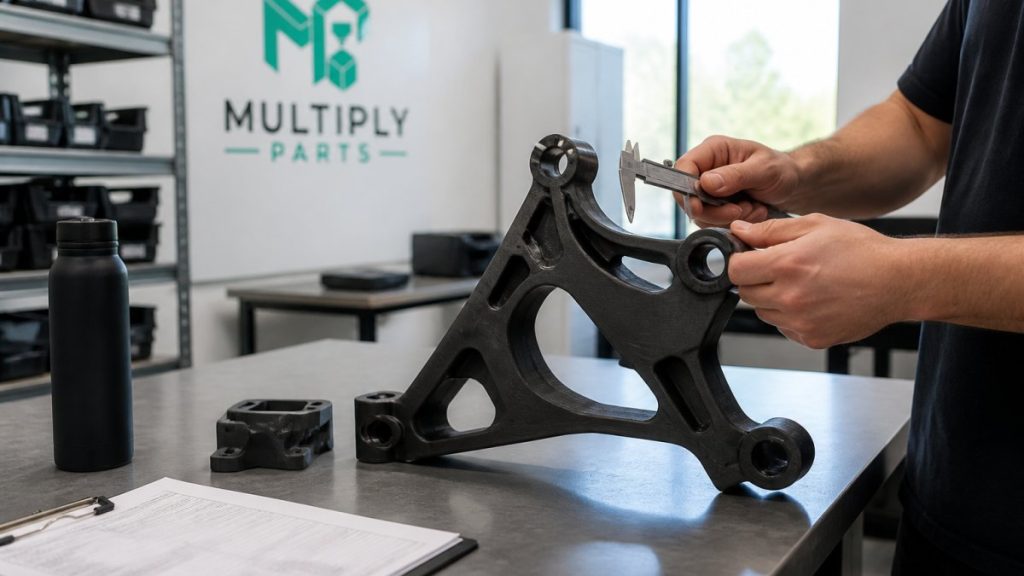
Part DNA: Why a Fully Tracked Manufacturing Process Wins
Last Updated: November 2, 2026
Quick Summary
Part dna is the complete record of a manufactured component’s origin, material, machine, settings, and handling, tied to a unique identifier that follows the part from raw stock to final shipment. It is the backbone of a fully tracked job, so the affected batch can be identified and isolated when something goes wrong.
- Tracking starts before the first layer goes down, with material logged on arrival.
- A fixed data set applied to every job, no exceptions, keeps records consistent.
- Start with the cheapest identifier that survives the process and meets customer verification needs.
- Validate the system by reconstructing a random finished part’s history from the record alone.
- Quarantine parts with missing records rather than shipping on assumption, and log the failure.
Table of Contents
- What Part DNA Means in a Fully Tracked Manufacturing Process
- Manufacturing Traceability: The Advantage of a Fully Tracked Process
- Part Traceability in Practice: What to Record for Every Component
- Track and Trace Technology in Manufacturing: Barcodes, RFID, and DNA Markers
- 3D Printing Quality Control: Where Part DNA Pays Off Most
- How to Build a Traceable Process: A Step-by-Step Implementation Guide
- Get an Instant Quote for Traceable Production
- Frequently Asked Questions
What Part DNA Means in a Fully Tracked Manufacturing Process
Part DNA is the complete record of a manufactured component’s origin, material, machine, settings, and handling, tied to a unique identifier that follows the part from raw stock to final shipment. Part DNA is best understood as the backbone of a fully tracked job. The record travels with the part, not in a folder someone forgets to open.
The concept borrows from biology. A physical part carries a signature of everything that made it. That signature includes the material batch, the printer or machine, the operator, the date, and the test results. Lose that signature and you have a part with no history.
From Raw Material to Finished Component
In a fully tracked process, tracking starts before the first layer goes down, with material logged on arrival.
A fully tracked chain generally runs through several checkpoints:
- Material intake: lot number, date received, storage location
- Job setup: machine ID, calibrated settings, operator sign-off
- Production: layer or cycle logs, in-process checks, timestamps
- Post-processing: finishing steps, curing, cleaning
- Final inspection: dimensional checks, visual review, pass or fail
- Dispatch: packaging record, shipping details, customer link
Each checkpoint adds a link to the chain. Break one and the record weakens.
Manufacturing Traceability: The Advantage of a Fully Tracked Process
Manufacturing traceability is the ability to reconstruct the full history of a part from its identifier alone. The advantage shows up when something goes wrong: the affected batch can be identified and isolated.
The alternative is guesswork. Without a tracked process, a defect forces you to question every part you made that week. That gets expensive.
Seven Benefits a Tracked Process Delivers
- Faster recalls. You isolate the exact batch instead of pulling everything.
- Cleaner audits. Records exist before anyone asks for them.
- Fewer repeat defects. Root causes surface because the data exists.
- Stronger supplier control. You know which material lots underperform.
- Better customer trust. Buyers can verify where their parts came from.
- **** Every unit is accounted for.
- Smoother scale-up. Processes repeat reliably as volume grows.
The National Research Council of Canada’s manufacturing guidance notes that documented process control is a core part of industrial competitiveness. We see the same thing on our floor: the jobs with the best records are the jobs that run cleanest.
Traceability also feeds supply chain resilience. When one material source dries up, a tracked process tells you exactly which parts are affected and which are not. For a deeper look at that side of things, see our guide on how to improve supply chain resilience.
Part Traceability in Practice: What to Record for Every Component
Part traceability works only if the data captured is consistent. A record with missing fields is nearly as useless as no record. The fix is a fixed data set applied to every job, no exceptions.
Here is the minimum field set we would record for any component:
| Data Field | Why It Matters | Example Format |
|---|---|---|
| Part ID | Unique reference for the component | MP-2026-04412 |
| Material lot | Traces failures to a source batch | PLA-BLACK-LOT-338 |
| Machine ID | Links defects to specific equipment | FDM-07 |
| Process settings | Lets you repeat a good run | Layer 0.2mm, 215C |
| Operator | Accountability and training gaps | Initials plus shift |
| Inspection result | Proves the part passed checks | Pass, dims within spec |
| Timestamp | Places the part in time | Date and time |
| Customer or order | Connects part to buyer | Order 88213 |
A common mistake is recording only what the machine logs automatically. Machine data misses handling, storage, and post-processing. Those steps cause plenty of failures.
Pair the record with a physical identifier. A barcode or engraved serial on the part keeps the digital record tied to the real object. Without that link, the record floats free.
Track and Trace Technology in Manufacturing: Barcodes, RFID, and DNA Markers
Track and trace technology in manufacturing covers a family of tools, each suited to different jobs.
Barcodes encode a unique ID in a printed pattern read by a scanner. They are cheap and well understood. Their limits are physical: labels peel, ink fades, and the scanner needs a clear line of sight.
RFID tags store an ID in a chip that responds to a radio signal.
DNA markers are traceable tags added to a material or applied to a surface, each carrying a unique code that can be read later to confirm origin.
Here is how the three compare on the criteria that usually decide the choice:
| Criterion | Barcode | RFID | DNA markers |
|---|---|---|---|
| Unit cost | Lowest | Moderate to high | Higher setup, low marginal cost at volume |
| Line of sight required | Yes | No | Depends on reading method |
| Survives harsh handling | Poor | Good | Good to excellent |
| Copy resistance | Low | Moderate | High |
| Best fit | Low-cost parts, simple tracking | Fast-moving inventory, bulk scanning | Provenance proof, anti-counterfeit, high-value parts |
A general selection rule is to start with the cheapest identifier that survives the process and satisfies the customer’s verification needs.
One point of confusion worth clearing up. Keeping biological production distinct from component traceability also clarifies why data accuracy in manufacturing matters: reliable part records help prevent automotive returns caused by mismatched or incomplete information.
3D Printing Quality Control: Where Part DNA Pays Off Most
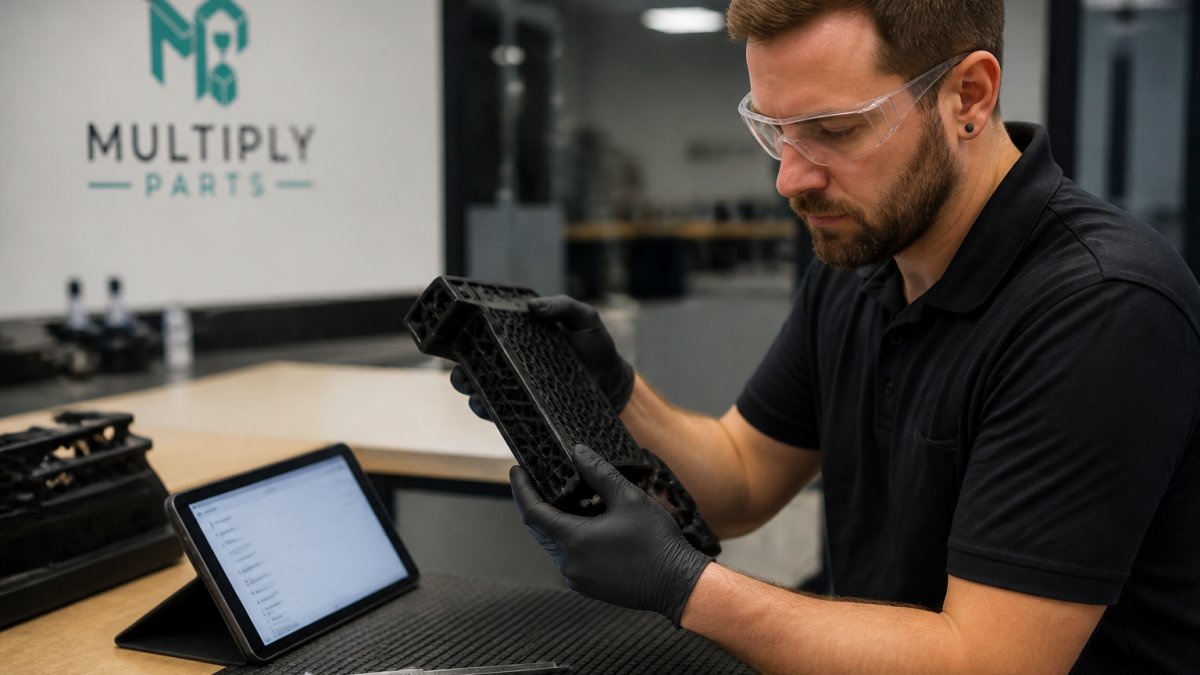
3D printing quality control depends on catching variation early. Printed parts can drift in dimension, strength, or finish as a machine wears or a material lot changes. A tracked record turns that drift into a visible trend instead of a surprise.
The payoff is biggest in a few areas:
- Sports equipment parts that take repeated impact and cannot afford hidden flaws
- EV accessory components where fit and heat resistance matter
- Short-run production where one bad batch hurts a small order badly
- Repeat orders where consistency between runs is the whole point
Quality control and quality assurance split the work. Quality control checks the part. Quality assurance checks the process. Part DNA supports both, because it holds the process data that explains why a part passed or failed.
Recording inspection results without linking them to the material lot and machine makes it hard to trace a defect back to its cause.
How to Build a Traceable Process: A Step-by-Step Implementation Guide
Building a traceable process is less about software and more about discipline. Start small, pick the fields that matter, and apply them to every job before adding complexity. The sequence below is the one most practitioners converge on, with the practical details that decide whether the system survives contact with production.
- Define your identifiers. Create a naming scheme for parts, lots, and machines that is unique, human-readable, and stable over time. Avoid embedding dates or operator names in the ID itself; keep those as separate fields so the ID never needs to change.
- Pick your capture method. Choose barcodes for most parts, RFID for fast-moving stock or hard-to-reach items, and DNA markers where provenance must be physically inseparable from the part. Match the method to the environment, not to the demo.
- Set the minimum data fields. Use the field table above as a starting point, then add only fields that someone will actually use to make a decision. Every extra field is a chance for a gap.
- Assign ownership. One person signs off on each checkpoint. Shared ownership is the most common cause of missing records.
- Run a pilot batch. Track one product line end to end, including post-processing and dispatch, because that is where records usually break.
- Review the gaps. Pull a finished part at random and reconstruct its history from the record alone. Every field you cannot fill is a process defect, not a paperwork inconvenience.
- Scale to all jobs. Apply the same fields everywhere. Inconsistent fields across lines defeat the purpose of a shared record.
- Audit on a schedule. Spot-check records against real parts and log the results. An audit that never finds anything is usually an audit that is not looking.
If you are moving a design from a one-off prototype into repeat production, our guide on how to transition from prototype to production walks through the handoff.
Validation, Accuracy, and Handling Failures
A traceability system is only as good as its accuracy. A traceability system can be validated by pulling a random finished part and reconstructing its full history from the record alone.
When a record is missing or a check fails, the part should be quarantined rather than shipped on assumption, and the failure should be logged, since repeated gaps point to a process problem.
Interoperability matters too. Your records should export cleanly to your customer’s systems and survive a software change. Keep backups, control who can edit records, and treat traceability data as a security asset, not an afterthought.
Finally, measure the system. Track the percentage of jobs with complete records, the time to reconstruct a part history, and the number of quarantines caused by missing data. Those three numbers tell you whether the process is improving or quietly eroding.
Get an Instant Quote for Traceable Production
Traceable production starts with a clean handoff of your design files. MultiplyParts offers no minimum order quantities and instant pricing so you can move from concept to parts without waiting on a sales call.
Our instant quoting flow lets you see current pricing before you commit to an order. If you would rather talk through your project first, you can contact our team directly.
To see why tracked production matters for your parts, read more about why teams choose MultiplyParts for precision manufacturing, flexible production, and complete traceability.
Frequently Asked Questions
What does part DNA mean in manufacturing?
Part DNA is the unique record attached to a single component: its material batch, machine, operator, print or process parameters, inspection results, and date. It works like a fingerprint for a physical part, so anyone can trace its history from raw material to delivery. In a fully tracked manufacturing process, that record is created automatically at each step rather than reconstructed after a problem appears.
How does part traceability improve manufacturing quality?
Part traceability ties every defect to the conditions that produced it. When a batch of EV brackets fails a tolerance check, you can pull the machine, material lot, and process settings for those exact units instead of inspecting everything. That shortens investigations, narrows recalls to affected serials, and gives you evidence for corrective action. It also supports 3D printing quality control, where layer-level parameters change part strength.
How can manufacturers trace a 3D-printed part from design to delivery?
Start with a unique identifier at the design file, then link it to the print job, material spool, machine calibration, and post-processing steps. Attach a barcode or RFID tag at packing and scan it at dispatch. Each scan updates the same record, so the chain of custody stays intact. The key is capturing data at the point of work, not typing it in later, because manual entry is where traceability records usually break.
What is the difference between product traceability and process traceability?
Product traceability follows the physical item: where it is, which batch it belongs to, and where it shipped. Process traceability follows how it was made: machine settings, temperatures, operator, and inspection outcomes. A fully tracked manufacturing process needs both, because a part’s identity is only useful if you can also see the conditions behind it. Most recalls need process data to explain why a defect occurred, not just which units are affected.
The gap between a part you can trust and one you cannot often comes down to its record. MultiplyParts builds that record into every job, with instant pricing, no minimum order quantities, and a wide range of high-performance materials for sports and EV components. Get started with MultiplyParts and turn your next design into a fully tracked, production-ready part.

