
3D Printing vs Injection Molding Cost: Which Wins?
Last Updated: November 8, 2026
Quick Summary
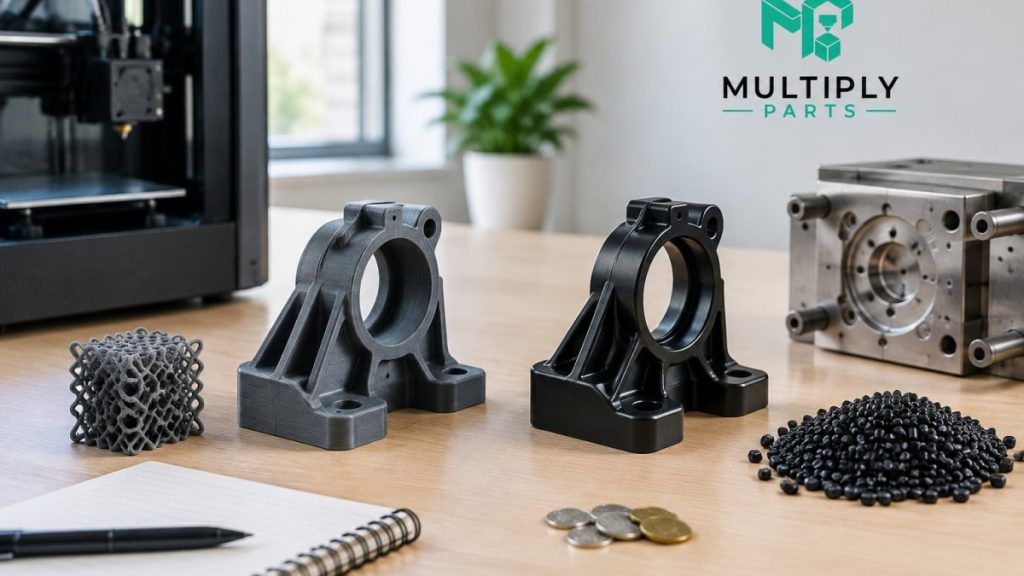
The 3d printing vs injection molding cost decision comes down to order quantity: 3D printing wins at low volumes because there is no tooling, while injection molding wins at high volumes because a steel mold spreads its cost across thousands of cheap parts. The break-even point depends on part size and complexity.
- 3D printing cost per part stays roughly flat whether you order one unit or fifty.
- Injection molding tooling cost is the single biggest number and is paid before any production part exists.
- Break-even quantity = Mold cost ÷ (3D printing cost per part − Injection molding cost per part).
- Injection molding typically requires a minimum run in the thousands to justify the tool, while 3D printing has no MOQ.
- Build a landed-cost sheet with one column per process and one row per cost line.
Table of Contents
- 3D Printing vs Injection Molding Cost: The Quick Comparison
- How Each Process Actually Works
- Injection Molding Tooling Cost: The Upfront Investment
- 3D Printing Cost Per Part: What Drives the Number
- 3D Printing vs Injection Molding Break-Even Point
- Low-Volume Manufacturing Methods Beyond the Two Main Options
- Design Freedom, Materials, and Quality Trade-Offs
- Total Landed Cost and Supply-Chain Risk
- Frequently Asked Questions
3D Printing vs Injection Molding Cost: The Quick Comparison
The 3d printing vs injection molding cost question comes down to one number: how many parts you need.
3D printing is additive manufacturing: a machine builds a part layer by layer from filament or resin, with no mold required.
| Factor | 3D Printing | Injection Molding |
|---|---|---|
| Upfront tooling | None | High mold cost |
| Cost per part | Flat, volume-stable | Drops sharply with volume |
| Best volume | 1 to a few hundred | Thousands and up |
| Lead time | Days | Weeks, including tooling |
| Design changes | Cheap and fast | Expensive once mold is cut |
| Surface finish | Good, layer lines possible | Excellent, mold-quality |
| Material choice | Wide, growing | Very wide, mature |
That table is the decision in miniature. The rest of this guide explains what drives each number, where the crossover sits, and which costs most buyers forget.
How Each Process Actually Works
Additive manufacturing builds parts from a digital file with no tooling investment, which is why it dominates prototypes and short runs. Injection molding requires a machined mold first, then produces parts at very low marginal cost.
Additive Manufacturing in Brief
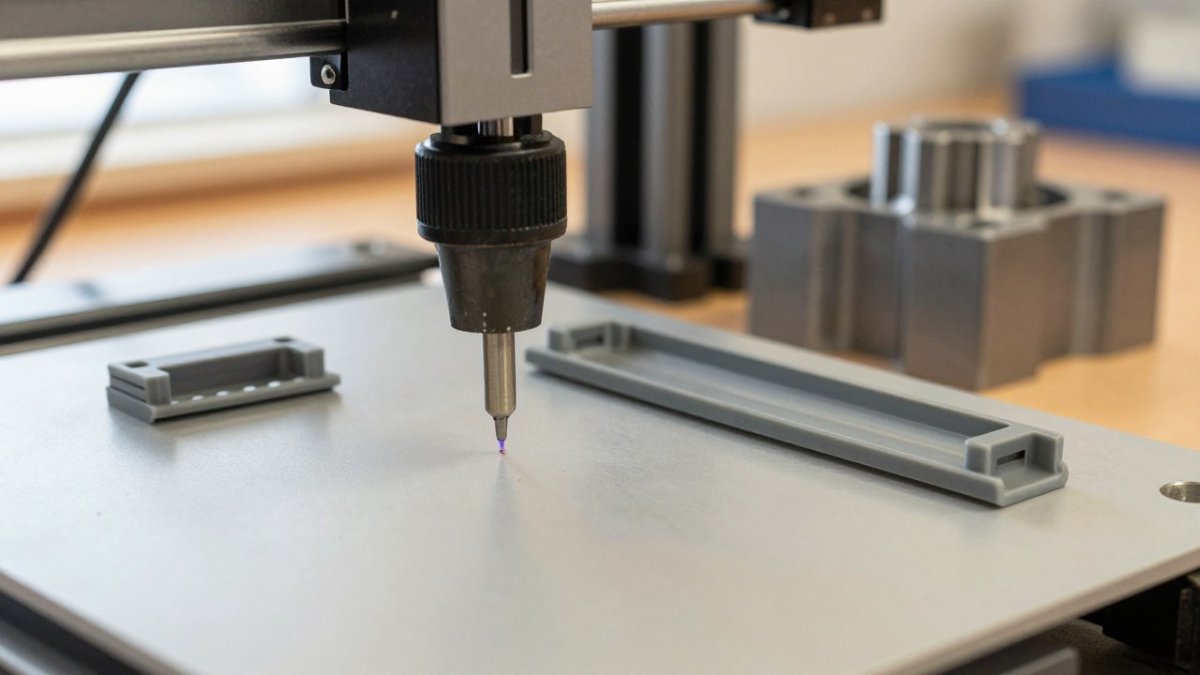
A 3D printer reads a CAD file, slices it into thin layers, and deposits or cures material one layer at a time. Setup is minimal: upload the file, choose a material, print. That is why 3D printing cost per part stays roughly flat whether you order one unit or fifty.
Injection Molding in Brief
Injection molding starts with mold fabrication. A machinist cuts a steel or aluminum cavity that matches your part geometry, complete with draft angles and a parting line. Once the mold is mounted, cycle time per part is measured in seconds. The mold, not the plastic, is where the money goes.
Injection Molding Tooling Cost: The Upfront Investment
Injection molding tooling cost is the single biggest number in this comparison, and it is paid before a single production part exists. A mold must be designed, machined, polished, and tested. Complex geometry, tight tolerances, and multi-cavity tools push the figure higher.
This is the line item that sinks small projects. For a deeper look at material costs, see our breakdown of industrial 3D printing material cost per kg.
3D Printing Cost Per Part: What Drives the Number
3D printing cost per part is driven by material, machine time, and finishing, not tooling. A larger part uses more material and build time. A resin part needing a smooth surface adds post-processing labor.
That stability cuts both ways. It makes quoting simple and predictable. It also means 3D printing rarely wins on pure unit economics at very high volumes.
3D Printing vs Injection Molding Break-Even Point
The 3d printing vs injection molding break-even point is the order quantity where total cost per part crosses between the two processes. Below it, 3D printing is cheaper because there is no tooling to amortize. Above it, injection molding pulls ahead as the mold cost spreads across more units. The crossover is not a single number, it moves with part size, material, mold complexity, finishing, and labor rates, so treat any published threshold as a starting assumption, not a quote.
The Cost Equation Behind the Crossover
A transparent break-even model uses five inputs. For 3D printing, total cost equals (material cost per part + machine time cost per part + post-processing labor per part) × quantity, plus any setup or file-preparation fee. For injection molding, total cost equals mold cost + (material cost per part + cycle time cost per part + finishing labor per part) × quantity, plus setup and sampling. The break-even quantity is the point where those two totals are equal:
Break-even quantity = Mold cost ÷ (3D printing cost per part − Injection molding cost per part)
That single line explains why the crossover swings so widely. A simple aluminum tool for a small bracket might land in the low thousands of dollars, while a hardened steel multi-cavity mold for a complex housing can run well into five figures. If 3D printing costs a few dollars per part and molding drops to under a dollar at volume, the gap per part is only a few dollars, so a low-thousands mold breaks even in the low thousands of units, while a five-figure mold pushes the crossover into the tens of thousands.
A Worked Example You Can Edit
Picture a small plastic bracket roughly the size of a phone case. Assume a per-part printing cost, a mold quote, and a molded per-part cost, then divide the mold cost by the per-part savings to estimate break-even.
Watch out: quoting a break-even without including finishing, labor, and scrap will understate the molded cost and overstate the printed cost, shifting the crossover in the wrong direction.
Where the Crossover Moves
Several factors push the break-even quantity up or down. Part size and complexity raise mold cost faster than they raise print cost, so complex geometries break even later. Tight tolerances and cosmetic surfaces add mold polishing and inspection cost, again delaying the crossover. Multi-cavity tools raise upfront cost but cut cycle time per part, which can pull the crossover earlier at very high volumes.
Beyond the Crossover: Total Cost of Ownership
Break-even is a manufacturing-cost calculation, not a business decision. A low-volume run that breaks even at 2,000 units may still be better printed if the design is likely to change, because a mold revision can cost a significant fraction of the original tool. If you are weighing whether a short run is worth it, read whether small batch manufacturing is worth it.
Low-Volume Manufacturing Methods Beyond the Two Main Options
Low-volume manufacturing methods do not stop at these two processes. When neither fits, several alternatives bridge the gap, each with its own cost profile and volume sweet spot.
- CNC machining: cuts solid stock; great for functional prototypes and bridge tooling.
- Urethane casting: silicone molds for tens to low hundreds of parts.
- Vacuum forming: thin-walled shells at modest tooling cost.
- Sheet metal fabrication: brackets and enclosures without a plastic mold.
For a fuller rundown, see our guide to alternatives to high MOQ manufacturing.
Design Freedom, Materials, and Quality Trade-Offs
Design complexity favors 3D printing: internal channels, lattice structures, and undercuts that would need complex mold slides print without extra tooling.
Material selection is close. Both processes draw on a broad thermoplastic range, and 3D printing adds resins and filaments tuned for heat resistance and impact. For EV battery enclosures or sports equipment that takes real impact, material validation matters more than process.
Total Landed Cost and Supply-Chain Risk
Total landed cost is the quoted part price plus every cost required to get a conforming part into your hands and keep it there. Most cost comparisons stop at the manufacturing quote, which is why they mislead. Landed cost can differ materially from the quoted part price once freight, duties, currency, and carrying costs are counted. The gap narrows, and sometimes reverses, at low and mid volumes.
The Cost Lines Competitors Skip
A complete landed-cost model for either process includes six lines beyond the part quote:
- Freight and duties: molded parts ship in bulk, so per-part freight is low but total freight is a fixed cost amortized across the order. Printed parts ship as finished units, so per-part freight is higher but there is no bulk minimum.
- Minimum order quantity (MOQ): injection molding typically requires a minimum run to justify the tool, often in the thousands, forcing you to buy and store parts you may not need for months. 3D printing has no MOQ.
- Inventory carrying cost: stored parts tie up cash and incur storage, insurance, and obsolescence risk. A large molded run sitting in a warehouse carries a real cost that may not appear on the part quote.
- Supplier lead time: molded parts can take weeks for tooling plus production plus shipping. Printed parts can ship in days. Long lead times force earlier ordering, which increases inventory and reduces your ability to respond to demand changes.
- Scrap and rework: a bad molded batch is expensive because tooling cost is already sunk and the whole run may be unusable. A bad printed batch is limited to units already produced, and design changes are cheap.
How the Two Processes Compare on Landed Cost
Injection molding tends to win on landed cost only when volume is high enough that per-part freight, duties, and carrying cost are small relative to the per-part manufacturing savings. At low volumes, MOQ and inventory carrying cost can erase the per-part advantage entirely. 3D printing can reduce landed cost at low and mid volumes because it avoids bulk minimums and shorter lead times reduce the need to hold safety stock.
Supply-Chain Risk Is a Cost Line
Risk has a price even when it does not appear on an invoice. A single mold failure close to a launch deadline can cost more than the tooling itself in expedited shipping, air freight, and lost sales. Overseas production can add border delays and quality disputes that are harder to resolve at distance. For startups watching every dollar, our guide to reducing manufacturing costs walks through where the real savings hide.
A Practical Way to Compare
Build a landed-cost sheet with one column per process and one row per cost line above. Fill in your real freight quote, MOQ, expected inventory holding period, and supplier lead time.
The real challenge is not choosing a process. It is knowing exactly when to switch, and having a manufacturing partner who can carry you across that line without a costly restart.
Frequently Asked Questions
Is 3D printing cheaper than injection molding?
It depends on quantity. For small runs, 3D printing cost per part is usually lower because there is no mold to cut. The crossover depends on part geometry, material, and tooling assumptions, so compare quotes at your actual order quantity.
At what production volume does injection molding become cheaper than 3D printing?
There is no single number, but the break-even point is where the mold’s upfront cost is paid back by lower per-part pricing. Injection molding becomes more competitive as volume rises, but the exact point depends on your part and tooling. Build your own break-even by dividing tooling cost by the per-part savings, then compare that to your realistic annual volume.
How much does injection mold tooling cost?
Tooling cost varies widely with part size, geometry, tolerance, and the number of cavities in the mold. Simple single-cavity tools for small parts sit at the low end; multi-cavity tools with tight tolerances and complex slides sit at the high end. Because the mold is a one-time investment, it dominates the economics of short runs. Ask for a tooling quote alongside per-part pricing so you can see the full picture before committing.
What is the cost per part for 3D printing versus injection molding?
3D printing cost per part is driven by material volume, print time, and post-processing, and it stays roughly flat as quantity rises. Injection molding cost per part falls sharply with volume because the tooling is amortized across more units. At low volumes the gap narrows or reverses. Always compare quotes at your actual order quantity.
Is 3D printing or injection molding better for low-volume production?
For low-volume manufacturing methods, 3D printing usually wins on total cost because it skips tooling entirely and allows design changes without new molds. Injection molding makes sense once your design is frozen and volume is high enough to absorb the tooling investment. Many teams run both: print prototypes and bridge production, then move to molding when demand is proven. That hybrid approach protects cash flow while you validate the market.

