

Best 3D Printing Materials for EV Parts: A Selection Guide
Last Updated: November 5, 2026
Quick Summary
The best 3d printing materials for EV parts are chosen by matching a filament’s thermal, mechanical, and chemical properties to the part’s service conditions. Nylon suits clips and mounts that flex or take impact, polycarbonate suits hot load-bearing brackets, and ASA suits UV-exposed exterior trim. PLA is limited to fit-check prototypes.
- Cabin interiors can exceed 60 °C in summer sun, so PLA softens in a parked car.
- Nylon handles up to about 90-110 °C and suits load-bearing clips, mounts, and hinges.
- Polycarbonate handles up to about 110-120 °C for structural brackets and covers near heat.
- Carbon-fiber-filled filaments are electrically conductive and must stay away from high-voltage conductors.
- Align layers with the main load path because FDM parts are weaker across layer lines.
Table of Contents
- Matching 3D Printing Materials to EV Operating Conditions
- The Strongest 3D Printing Material Depends on Load and Heat
- High-Temperature 3D Printing Filament for Cars: Under-Hood and Cabin Limits
- 3D Printing Materials for EV Battery Components and High-Voltage Safety
- Nylon vs Polycarbonate 3D Printing for Functional EV Parts
- Print Orientation, Anisotropy, and Design for Service
- Getting an Instant Quote for Your EV Part
- Frequently Asked Questions
Matching 3D Printing Materials to EV Operating Conditions
Choosing the best 3d printing materials for ev work starts with one question: what will the part actually endure?
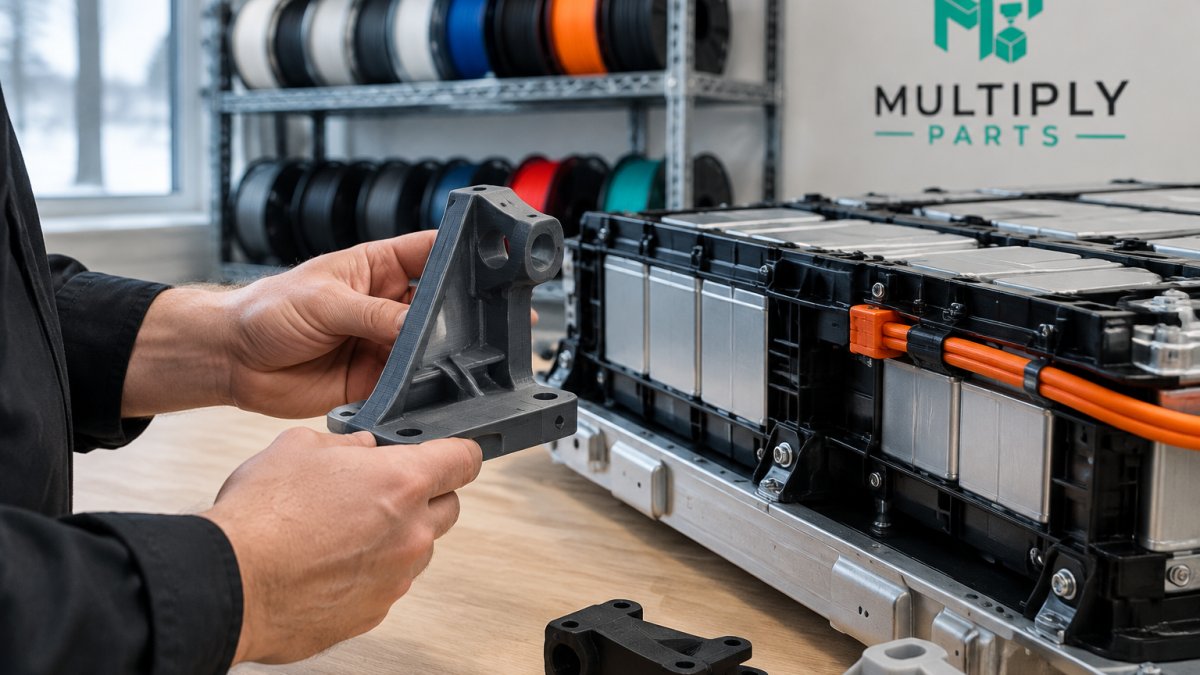
Material selection for electric vehicle parts is the process of matching a filament’s mechanical, thermal, and chemical properties to the conditions a specific component will meet in service.
The four conditions that decide most EV material choices:
- Temperature: under-hood and battery-adjacent zones run hotter than cabin trim
- Load type: static brackets behave differently from clips that flex
- Chemical exposure: coolant, oils, and cleaning agents attack some polymers
- UV and weather: exterior parts need UV-stabilized grades
For a broader ranked list of industrial options, our guide to the 5 best industrial 3D printing materials for EV parts is the natural companion to this section.
The Strongest 3D Printing Material Depends on Load and Heat
No single filament wins on every axis. The strongest 3D printing material for a given EV part is the one whose tensile strength, impact resistance, and heat deflection all clear the part’s real duty cycle.
Use this selection matrix to match material families to EV-specific operating conditions. The temperature ranges below are typical service envelopes, not datasheet maximums; always derate for sustained load and real-world cycling.
| Material | Typical continuous service temp | Strength and stiffness | Impact and toughness | Print difficulty | Chemical resistance notes | Suitable EV applications |
|---|---|---|---|---|---|---|
| PLA / tough PLA | Up to about 50-55 °C | Moderate | Low to moderate | Easy | Poor against many solvents and fuels | Fit-check prototypes, non-functional mockups, display models only |
| PETG | Up to about 65-70 °C | Good | Good | Easy to moderate | Moderate; can be attacked by strong solvents | Interior brackets away from direct heat, cable covers, low-load trim |
| ABS | Up to about 80-90 °C | Good | Moderate | Moderate; warping risk | Moderate; susceptible to some oils and cleaners | Interior housings, non-UV exterior parts, prototypes near cabin heat |
| ASA | Up to about 85-95 °C | Good | Moderate | Moderate | Moderate; better UV stability than ABS | Exterior trim, mirror housings, UV-exposed covers |
| Nylon (PA6/PA12) | Up to about 90-110 °C | High | High | Moderate to hard; moisture sensitive | Good against many oils and greases; moisture absorption affects dimensions | Load-bearing clips, mounts, hinges, parts that flex or take impact |
| Polycarbonate | Up to about 110-120 °C | High | High | Hard; warping and high nozzle temps | Moderate; can be stress-cracked by some solvents | Structural brackets, covers near heat sources, load-bearing interior parts |
| Carbon-fiber-filled (PA, PC, PETG base) | Varies by base polymer; often 90-120 °C | Very high stiffness | Lower elongation; more brittle than base | Hard; abrasive to nozzle | Depends on base resin; carbon fibers do not improve chemical resistance | Stiff structural parts, jigs, fixtures, dimensionally stable brackets |
| PEEK, PPS, PEKK | Above 150 °C for many grades | Very high | High | Very hard; requires heated chamber and high temps | Excellent against many fluids and solvents | Demanding under-hood parts, high-heat fixtures, applications where validated |
A common mistake is treating PLA as a finished-part material.
The second mistake is choosing by tensile strength alone.
Watch out: published heat deflection temperatures are measured under a specific load and do not predict creep under sustained bracket preload.
High-Temperature 3D Printing Filament for Cars: Under-Hood and Cabin Limits
Heat is where most hobbyist material choices break down. A high-temperature 3D printing filament for cars must hold its shape well above the temperatures a cabin or engine bay reaches in summer sun and after shutdown.
Practical limits to design around:
- PLA and tough PLA: fine for prototypes, unsuitable for hot cabins or engine bays
- PETG: acceptable for interior brackets away from direct heat
- ABS and ASA: better heat resistance, with ASA preferred for outdoor UV exposure
- Polycarbonate: a strong choice for hot, load-bearing interior and under-hood parts
- PEEK and PPS carbon fiber: reserved for the most demanding high-heat applications
For a ranked shortlist of heat-resistant options, our roundup of the 7 best heat resistant 3D printing filaments covers grades and trade-offs in more detail.
Watch out: heat deflection temperature is measured under a specific load, so a filament rated for a high temperature can still creep under a sustained bracket load. Always derate the published figure for real service.
3D Printing Materials for EV Battery Components and High-Voltage Safety
Battery and high-voltage areas demand more caution than any other zone on the vehicle. 3D printing materials for EV battery components must be treated as non-structural unless they have been validated for the application, and printed parts should never replace certified enclosures, insulation, or retention hardware. Keeping printed parts away from high-voltage systems also clarifies where material selection can be more flexible, such as non-critical off-road vehicle accessories that still need to withstand their operating environment.
Start by separating what a printed part is allowed to do near a battery or high-voltage system:
- Permitted without validation: prototype fit-check tools, non-contact assembly aids, cable routing guides that are mechanically isolated from conductors, and low-voltage sensor housings that are not part of the high-voltage enclosure.
- Requires engineering sign-off and testing: any part that contacts a cell, module, busbar, or high-voltage conductor; any part that contributes to retention, sealing, or thermal management; any part inside a battery enclosure.
- Never acceptable as a substitute: certified enclosures, insulation barriers, flame barriers, cell retention hardware, and any component whose failure could expose live conductors or compromise thermal runaway containment.
Material behavior in a fault event matters more than room-temperature datasheets.
Chemical exposure in battery and drivetrain zones is also underestimated. Coolant (often glycol-based), dielectric oils, brake fluid, and cleaning agents can attack or swell some polymers, and road salt accelerates corrosion of any metallic inserts or fasteners.
Where a printed part sits near high-voltage hardware, keep it mechanically isolated, avoid trapping heat, and route it so a failure cannot contact live conductors.
Watch out: a filament marketed as “flame retardant” or “self-extinguishing” is not automatically suitable for battery-adjacent use.
Nylon vs Polycarbonate 3D Printing for Functional EV Parts
Nylon and polycarbonate are the two workhorses for functional printed parts, and the right pick depends on whether you need toughness or stiffness. Nylon (polyamide) offers high strength, good impact resistance, and excellent layer adhesion, which suits clips, mounts, and parts that flex and take knocks. Polycarbonate brings higher stiffness and better heat resistance, which suits structural brackets and covers exposed to heat.
The trade-offs are real. Nylon absorbs moisture, so it needs dry storage and careful drying before printing, and it can creep under sustained load. Polycarbonate is stiff and heat-tolerant but harder to print, prone to warping, and more demanding on the machine. Carbon-fiber-filled grades of either push stiffness higher, at the cost of reduced elongation and higher nozzle wear.
A quick decision framework:
- Part flexes or takes impact: start with nylon
- Part carries load and sees heat: start with polycarbonate
- Part needs maximum stiffness: evaluate a carbon-fiber-filled grade
For a deeper head-to-head, our comparison of carbon fiber vs nylon for functional prototypes breaks down where each wins. If you are still weighing the two base polymers, our nylon vs polycarbonate 3D printing breakdown covers anisotropy and heat-related failure modes in depth.
Print Orientation, Anisotropy, and Design for Service
Even the right material fails if the part is printed in the wrong orientation. FDM parts are anisotropic: strength along the layers is higher than strength across them, so a bracket loaded perpendicular to its layer lines can split far below the material’s rated strength. Orientation is a design decision, not a printer setting.
Design rules we apply to EV parts:
- Align layers with the main load path so tension runs along the extrusion direction
- Increase wall thickness before infill for load-bearing sections
- Round internal corners to reduce stress concentration
- Add ribs for stiffness instead of printing solid
- Design for service: allow access for fasteners and removal without disassembly
Watch out: a part that passed a static test can still fail in service if vibration and heat combine with a weak layer orientation. Our guide to why 3D printed parts fail under high heat covers the fix path when a design does not hold up.
Getting an Instant Quote for Your EV Part
Once the material, orientation, and design are set, the next step is pricing the part against your production volume. MultiplyParts offers instant pricing with no minimum order quantities, so a single prototype and a short production run both get a real number without a sales cycle. MultiplyParts specializes in the EV and sports markets and is proudly manufacturing in Canada.
Upload your CAD file to get an instant quote. To see exactly how that works before you commit a file, our walkthrough of how instant 3D printing quotes work explains supported formats, how the price is calculated, and what happens after upload.
Frequently Asked Questions
What is the best 3D printing material for electric vehicle parts?
There is no single best material; the right choice depends on where the part sits and what it must survive. PETG suits interior brackets and covers that see moderate heat and load. ASA handles outdoor exposure and sunlight. Nylon and polycarbonate are the stronger options for load-bearing and under-hood parts. For battery-adjacent components, material choice must also account for dielectric behavior and validation testing before the part goes near high-voltage hardware.
Which 3D printing materials can withstand high temperatures in a vehicle?
Cabin parts can see temperatures well above ambient on a sunny day, and under-hood areas run hotter still. Standard PLA softens at low temperatures and is a poor fit for either. PETG, ASA, nylon, and polycarbonate all hold up better, with polycarbonate and reinforced nylon handling the highest sustained heat. Always check the heat deflection temperature of the specific grade rather than the generic material name, and test a sample in the real location before committing to a production run.
Is nylon or polycarbonate better for functional automotive parts?
Nylon wins on impact resistance and flexibility, which suits clips, brackets, and parts that take shock. Polycarbonate wins on stiffness and heat resistance, which suits structural brackets and parts near heat sources. Nylon absorbs moisture over time, so it needs dry storage and sometimes annealing. Polycarbonate is harder to print and more prone to warping. The decision usually comes down to whether the part needs to flex or stay rigid, and how hot it gets.
Which materials are suitable for EV battery enclosures and electrical components?
Battery-adjacent parts carry safety implications that general automotive parts do not. Flame-retardant grades of nylon or polycarbonate are worth shortlisting, and any material used near high-voltage hardware needs dielectric testing and validation against the relevant standards before production. Consumer-grade filament is rarely qualified for this role. For prototypes and non-structural covers, PETG or ASA can work, but confirm the material’s electrical and flammability data with the supplier first.
Can 3D-printed parts withstand automotive fluids and chemicals?
It depends on the fluid and the material. PETG resists many common chemicals but degrades with some solvents. Nylon handles oils and fuels reasonably well but absorbs moisture. Polycarbonate is vulnerable to certain solvents and can stress-crack. EV coolant, brake fluid, and cleaning agents each behave differently against each material. Soak-test a printed sample in the actual fluid it will contact before approving a design, and re-test after any material or supplier change.
What 3D printing materials resist UV exposure for exterior vehicle parts?
ASA is the standard choice for outdoor parts because it resists UV degradation far better than ABS. PETG also holds up reasonably in sunlight, though it can yellow over time. Standard PLA and nylon degrade quickly with prolonged UV exposure. For exterior trim, mirror housings, or accessories that live outdoors, ASA or a UV-stabilized grade is the safer bet. Painting or coating a printed part adds another layer of protection regardless of material.
Your material choice only pays off if the part is printed to match it. MultiplyParts pairs a broad range of high-performance materials with instant pricing, no minimum order quantities, and fast turnaround, so you can move from a validated design to a production-ready EV part without guesswork. Get started with MultiplyParts and turn your next EV component into a priced, manufacturable part today.

