
3D Print Shop Near Me: Industrial Printing Services Guide
Table of Contents
- What a 3D Print Shop Near Me Actually Offers
- Printing Technologies: FDM, SLA, and SLS Compared
- Industrial 3D Printing Services for Production Runs
- Rapid Prototyping Manufacturing: From STL File to First Part
- Materials, Filaments, and Resins: Choosing What Fits
- Instant Quote Process, Turnaround Times, and Shipping
- Post-Processing and Design for Additive Manufacturing
- Cost-Saving Tips and Material Recycling for Large Projects
- Frequently Asked Questions
Last Updated: September 18, 2026
What a 3D Print Shop Near Me Actually Offers
A 3D print shop offers local manufacturing services that transform digital files into physical parts, providing industrial 3D printing without the lengthy lead times and shipping expenses associated with overseas suppliers. MultiplyParts operates this type of service for sports and electric vehicle brands, featuring instant pricing and no minimum order quantities.
The term “3D print shop” encompasses many services. A hobbyist shop typically produces small decorative items using desktop machines. In contrast, an industrial shop manufactures functional components engineered to withstand demanding conditions like vibration, heat, and impact. Understanding this distinction is crucial to avoid weeks of rework.
Hobbyist Printing vs. Industrial-Grade Output
Hobbyist printing prioritizes affordability and smaller part dimensions. Print volumes are usually measured in centimeters, materials are limited to common thermoplastics, and dimensional accuracy is often less critical.
Industrial-grade output represents a different standard. It involves using engineering-grade materials, adhering to documented process parameters, and producing parts that maintain their mechanical properties throughout a production run. This difference is most significant when a part is subjected to load or must fit precisely within an assembly with tight tolerances.
Printing Technologies: FDM, SLA, and SLS Compared
Fused Deposition Modeling (FDM) constructs parts by extruding molten thermoplastic through a nozzle, building layer by layer. Stereolithography (SLA) solidifies liquid resin using a laser or light source. Selective Laser Sintering (SLS) fuses powdered polymer with a laser, a process that typically requires no support structures.
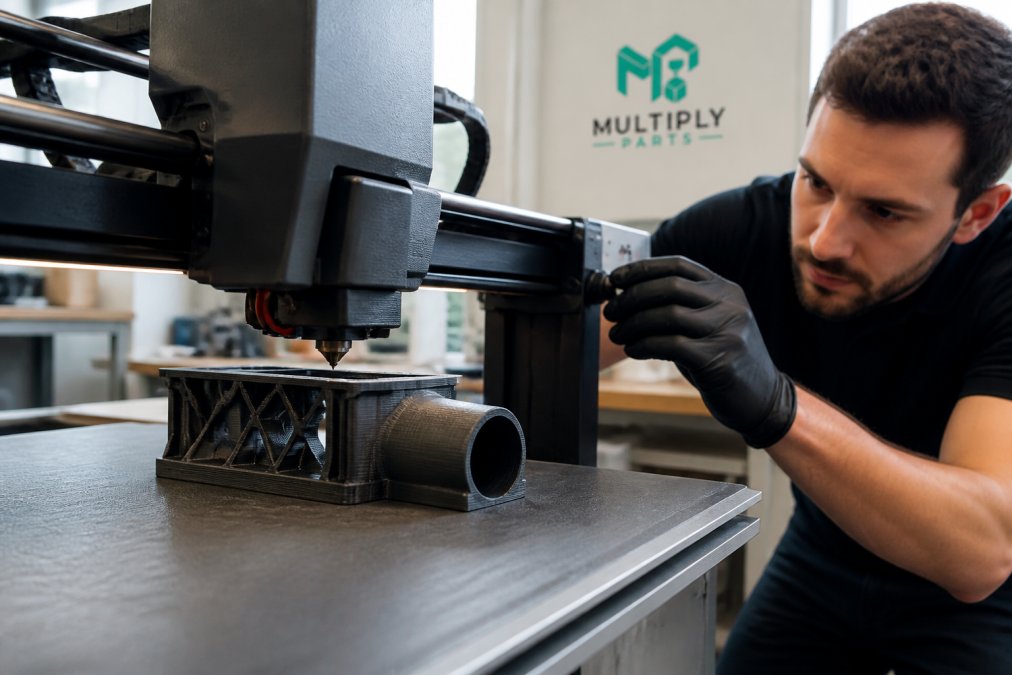
Each printing technology is suited for different applications:
| Technology | Best For | Typical Materials | Surface Finish |
|---|---|---|---|
| FDM | Brackets, housings, jigs | Thermoplastics, composites | Visible layer lines |
| SLA | Visual prototypes, fine detail | Resins | Smooth, high detail |
| SLS | Complex functional parts | Nylon, engineering polymers | Uniform, matte |
Industrial 3D Printing Services for Production Runs
Industrial 3D printing services distinguish themselves from one-off printing through their emphasis on repeatability. A production run necessitates that every unit precisely matches the approved sample, regardless of whether the order is for 50 or 500 pieces.
Batch Production and On-Demand Manufacturing
Batch production allows for printing a specific quantity in a single run, ensuring consistent material properties across all units. On-demand manufacturing, conversely, produces parts as orders are received. For e-commerce brands in the sports and EV accessory sectors, on-demand manufacturing eliminates the inventory risk associated with large upfront production runs.
Rapid Prototyping Manufacturing: From STL File to First Part
Rapid prototyping manufacturing significantly shortens the time between having a design file and possessing a physical part ready for testing. A typical cycle can take a design from CAD to a printed prototype in a matter of days, rather than weeks.
Preparing Your CAD Design and 3D Model
Most issues encountered during the printing process stem from the digital file, not the printer itself. Before uploading an STL file, it’s essential to verify three key aspects:
- Wall thickness. Walls thinner than the minimum print thickness for the chosen process may print weakly or fail entirely.
- Print orientation. The orientation affects the placement of layer lines and the attachment points for support structures.
- Tolerances. Specify the required fit tolerances for mating parts, not just their nominal dimensions.
Materials, Filaments, and Resins: Choosing What Fits
Material selection is a critical factor in determining a part’s performance and longevity in its intended application. Filaments and resins vary in their heat resistance, impact strength, stiffness, and chemical resistance, and no single material excels in all these areas. The most practical approach is to first define the operating conditions, then select the material family that best meets those requirements.
Common Material Families and Where They Fit
- PLA. Easy to print, dimensionally stable, and cost-effective. It exhibits poor heat resistance and is brittle under impact. Best suited for visual models, jigs that experience no significant load, and low-stress enclosures.
- PETG. Offers improved impact resistance and moderate heat resistance compared to PLA, with good layer adhesion. It’s a common choice for functional brackets, housings, and parts requiring some flexibility without cracking.
- ABS and ASA. Provide higher heat resistance and toughness but are prone to warping without an enclosed printer. ASA offers enhanced UV stability, which is important for outdoor sports equipment and vehicle exterior components.
- Nylon (PA) and glass- or carbon-filled nylon. These materials boast high impact strength, good fatigue resistance, and are excellent for functional end-use parts. Nylon’s tendency to absorb moisture means it must be dried properly before printing.
- Polycarbonate (PC). Features very high heat resistance and impact strength but is demanding to print and typically reserved for specialized engineering applications.
- Resins (SLA/DLP). Deliver a smooth surface finish and fine detail. Standard resins can be brittle; engineering and tough resins offer improved impact resistance at the expense of some fine detail. They are suitable for visual prototypes, molds, and small precision parts.
- SLS nylon powders. Provide isotropic strength (no weak layer lines), enable complex geometries without supports, and are well-suited for functional end-use parts and small production runs.
Matching Material to Application
Always request the material’s technical data sheet before committing to a production run. Key metrics like heat deflection temperature, impact strength (often reported as notched Izod), and tensile strength offer more insight into real-world performance than marketing descriptions.
If you are uncertain about the best material choice, seek technical support to validate your selection against your application’s requirements before proceeding with printing. Most service providers will flag a mismatch between the material and the stated use case if you clearly describe the load, temperature, and environment the part will encounter.
Instant Quote Process, Turnaround Times, and Shipping
An instant quote process provides a price immediately after you upload your file and select a material, quantity, and desired finish. MultiplyParts has designed its workflow around this, enabling you to receive a price without manual review delays. The quote accurately reflects the factors the shop uses for job scheduling, ensuring the price remains valid once the file is approved.
What Drives the Quote
Four primary factors significantly influence the cost:
- Material volume. This is determined by the part’s size, infill density, and the amount of support material required.
- Print time. Machine hours represent the largest cost component for most jobs. Taller parts and higher infill densities increase print duration.
- Material type. Engineering-grade polymers and high-temperature materials are typically more expensive per kilogram than standard PLA or PETG.
- Post-processing. While support removal is usually included, services like sanding, vapor smoothing, dyeing, and assembly are quoted separately.
Turnaround Times
Turnaround time is influenced by part complexity, material availability, and order volume. Simple FDM parts generally have faster turnaround times than SLS production runs, and large batches naturally take longer than single units. As a general guideline, single FDM parts move through the queue quickly, whereas SLS and multi-part batches are scheduled based on build chamber capacity, as parts from different orders are often consolidated into a single build.
Uploading a file with mesh geometry errors will delay all subsequent steps. Run a repair pass on your STL file before requesting a quote to avoid re-quoting after the problem is identified.
Cost-Saving Tips for Large Projects
Large projects benefit significantly from careful planning. Implementing a few key practices can consistently reduce costs:
- Nest multiple parts in one build. Maximizing the use of the print bed amortizes setup and machine time across more units. Nesting is standard practice for SLS; for FDM, it involves orienting parts to efficiently share the build plate.
- Reduce infill density where load allows. Infill density directly impacts material consumption and print time. Parts that primarily need to maintain their shape can often function effectively with a low infill percentage.
- Orient parts to minimize supports. Supports consume material and require manual removal, adding labor costs. Designing self-supporting geometry eliminates this step and associated expense.
- Standardize on one material. Minimizing material changes reduces setup time and purge waste.
- Batch similar parts together. A single run of identical or similar parts is more cost-effective per unit than multiple small runs spread over time.
Post-Processing and Design for Additive Manufacturing
Post-processing transforms a raw printed part into a finished product. Services such as support removal, sanding, vapor smoothing, and dyeing enhance a part’s appearance and performance but also add to the overall cost and lead time.
Cost-Saving Tips and Material Recycling for Large Projects
Large projects reward planning more than negotiation. A few practices consistently reduce cost:
- Nest multiple parts in one build. Filling the print bed amortizes setup across more units.
- Reduce infill density where load allows. Infill density drives material use and print time.
- Standardize on one material. Fewer material changes mean fewer setups.
- Design out supports. Self-supporting geometry removes a manual step.
Frequently Asked Questions
How much does it cost to have someone 3D print something?
Cost depends on part volume, material, layer height, and infill density. A small prototype in standard filament costs far less than an engineering-grade part in resin or nylon. MultiplyParts publishes pricing on its website and offers an instant quote tool, so you can upload your 3D model and see a figure before committing. No minimum order quantities apply, which keeps small runs affordable for startups and hobbyists.
What is the difference between hobbyist and industrial 3D printing?
Hobbyist printers run single units with looser dimensional accuracy and limited material options. Industrial 3D printing services use calibrated machines, engineering-grade thermoplastics and resins, and documented quality checks that hold across batch production. If your parts need consistent mechanical properties, heat resistance, or a professional finish, industrial-grade output is the safer route, especially when you scale from 50 units to 500 a month.
How do I prepare my files for professional 3D printing services?
Export your part as an STL file or a step file from your CAD design, then check the mesh for holes or non-manifold edges. Set the correct units in millimeters, and confirm wall thickness suits your chosen nozzle diameter. Think about print orientation and where support structures will sit, since these affect surface finish and strength. Most shops, including MultiplyParts, review your file before printing and flag issues early.
How long does it take to get a custom 3D printed part?
Turnaround time depends on part size, technology, and post-processing needs. A single FDM prototype can ship within days, while SLA or SLS parts with finishing take longer. Batch orders are scheduled around print volume and machine availability. MultiplyParts offers fast turnaround times and will confirm a date when you request your instant quote, so you know before production starts.
Scaling from a single prototype to a repeatable production run is where most 3D printing projects stall. MultiplyParts handles that transition with no minimum order quantities, instant pricing, and fast turnaround times, backed by manufacturing infrastructure built for the sports and electric vehicle markets. Get an Instant Quote and turn your next design into a production-ready part.
