

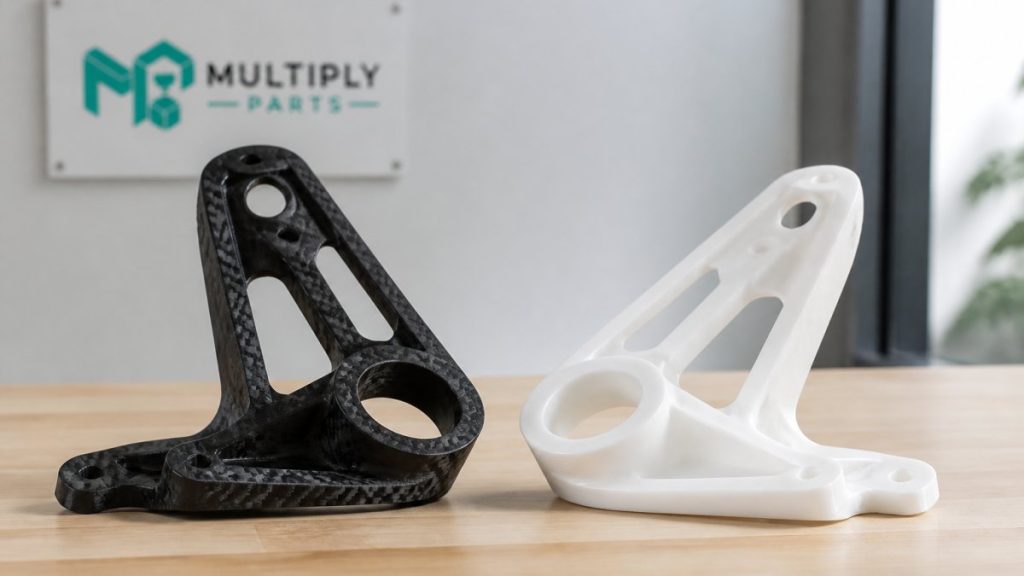
Carbon Fiber vs Nylon for Functional Prototypes
Last Updated: October 26, 2026
Quick Summary
For carbon fiber vs nylon for functional prototypes, carbon-fiber-reinforced nylon wins on stiffness and dimensional stability, while unfilled nylon wins on impact toughness and elongation before break. Choose based on whether your part must resist bending or absorb a hit, not on which material is stronger.
- A 5% carbon fiber load gives a modest stiffness bump with better layer adhesion and easier printing than 15%.
- Unfilled nylon often reaches 20%+ elongation at break, while chopped CF nylon stays in the single digits.
- Chopped carbon fiber is abrasive, so a hardened nozzle is not optional on CF nylon.
- Dry both nylons before every run and store them sealed, since wet filament prints with pops and weak layers.
- Print orientation decides strength: the same filament and geometry can differ by a large factor depending on layer direction.
Table of Contents
- Carbon Fiber vs Nylon: The Comparison Table
- What Carbon-Fiber-Reinforced Nylon Does to a Prototype
- Nylon 3D Printing: What Unfilled Nylon Brings to Functional Parts
- Mechanical Properties, Impact Resistance and How Parts Fail
- Printability, Nozzle Wear and Moisture Management
- Nylon vs PC Filament: Where Polycarbonate Fits In
- Applications: Automotive, Aerospace and Sports Parts
- Cost and Total Workflow Trade-Offs
- Frequently Asked Questions
Carbon Fiber vs Nylon: The Comparison Table
The short answer on carbon fiber vs nylon for functional prototypes: carbon-fiber-reinforced nylon wins on stiffness and dimensional stability, while unfilled nylon wins on impact toughness and elongation before break. Choosing between carbon fiber vs nylon for functional prototypes comes down to whether your part needs to resist bending or absorb a hit. The split is rarely about which is “stronger.” It’s about which failure mode your design can survive.
| Property | Carbon-Fiber Nylon (chopped) | Unfilled Nylon (PA6/PA12) |
|---|---|---|
| Stiffness | High | Moderate |
| Tensile strength | Higher | Lower |
| Elongation | Low, brittle | High, ductile |
| Impact resistance | Lower | Higher |
| Abrasiveness | High, wears nozzles | Low |
| Moisture uptake | Reduced | Higher |
| Best for | Rigid brackets, housings | Snap fits, living hinges |
What Carbon-Fiber-Reinforced Nylon Does to a Prototype
Carbon-fiber-reinforced nylon is a nylon base resin loaded with short chopped fibers, and those fibers change how a part behaves under load. The fibers raise stiffness and cut elongation, so a bracket that flexed in plain nylon now holds its shape. For a deeper look at where that trade pays off, see the benefits of carbon fiber reinforced 3D printing in detail.
Fiber Percentage: 5% vs 15% Carbon Fiber
More fiber means more stiffness and more brittleness. A 5% carbon fiber load gives a modest stiffness bump with better layer adhesion and easier printing. A 15% carbon fiber load pushes stiffness and dimensional stability further but narrows the processing window. The spec sheet matters more than the marketing label here.
Chopped Fiber Filament vs Continuous Carbon Fiber
Chopped fiber filament is printable on ordinary FFF machines and gives isotropic-ish gains in the XY plane. Continuous carbon fiber, laid by a specialized head, delivers far higher strength along the fiber direction but is a different process entirely. If you’re weighing the two, a PC-CF chopped-fiber material page shows what a real chopped option looks like in practice.
Nylon 3D Printing: What Unfilled Nylon Brings to Functional Parts
Nylon 3D printing with unfilled resin produces parts that bend, snap back, and take impacts without shattering. That ductility is why unfilled nylon still owns snap fits, clips, and anything that flexes in service. It also absorbs moisture, which changes dimensions over time, and it prints hotter and slower than PLA. The material rewards patience.
Mechanical Properties, Impact Resistance and How Parts Fail
Most comparisons stop at “carbon fiber is stiffer, nylon is tougher.” That is true but useless at the design-review stage, because the numbers move with fiber loading, print orientation, moisture content, and test method. The table below gives the ranges most practitioners report for chopped carbon-fiber nylon versus unfilled PA6/PA12, with the conditions that matter stated alongside each property. Treat these as planning ranges, not datasheet guarantees, your spool, your printer, and your orientation will shift them.
| Property | Chopped CF Nylon (10-15% fiber) | Unfilled Nylon (PA6/PA12) | Conditions that move the number |
|---|---|---|---|
| Tensile strength | Higher, roughly 1.3-1.8× unfilled | Baseline | Measured in XY (flat); Z-direction values drop sharply for both |
| Tensile modulus (stiffness) | Roughly 2-4× unfilled | Baseline | Scales with fiber percentage; 15% load noticeably stiffer than 5% |
| Elongation at break | Low, often single-digit percent | High, often 20%+ | Drops further with higher fiber load and with moisture loss after drying |
| Impact resistance (notched) | Lower | Higher | Unfilled nylon absorbs sharp hits; CF nylon can crack |
| Heat deflection | Higher | Lower | Both improve with annealing; CF holds shape at higher service temps |
| Layer adhesion (Z strength) | Lower | Higher | Both are anisotropic; CF amplifies the gap |
The three failure modes, and which material survives which
Parts fail in three ways, and each maps to a different material choice:
- Bending too far (excessive deflection). A bracket that flexes under load and contacts something it shouldn’t. Carbon-fiber nylon resists this because its modulus is several times higher, the same geometry deflects less. This is the failure mode CF nylon is bought for.
- Cracking under sharp impact. A dropped housing or a part struck by a tool. Unfilled nylon deforms and recovers; CF nylon has low elongation and can crack or shatter. If your prototype will be drop-tested or hit in service, unfilled wins.
- Delamination between layers. The layer lines are the weak plane in any FFF part. CF nylon’s lower Z-strength makes delamination more likely under peel or tensile loads applied across layers. Orientation and fiber loading both matter here.
A fourth mode, creep under sustained load, favors CF nylon, because the fibers resist slow deformation that unfilled nylon tolerates over weeks.
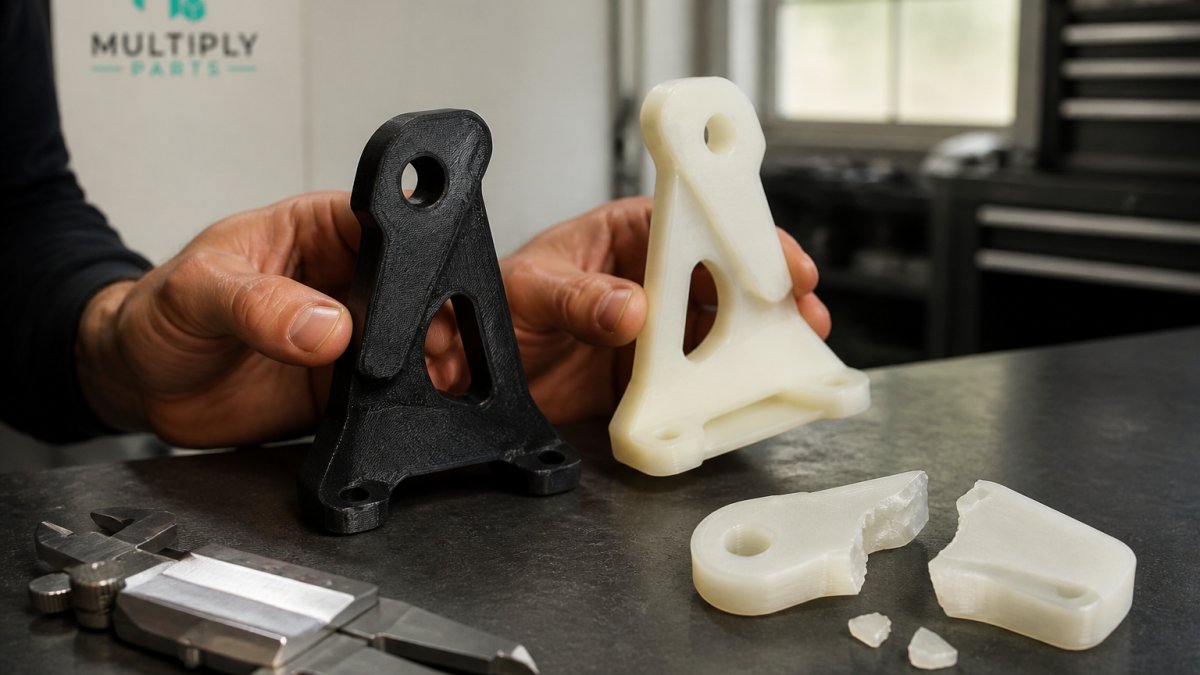
Anisotropy: why print orientation decides strength
A 3D-printed part is weakest along its layer lines, and the gap is larger for CF nylon than for unfilled. Print a bracket flat and the layers run across the load path; print it upright and they run along it. The same filament and the same geometry can differ by a large factor in measured strength depending on orientation, which is why any property number quoted without orientation is close to meaningless.
Before comparing filaments, decide the load direction. If the dominant load pulls across layer lines, neither nylon variant is strong in that direction, redesign the part or change orientation first, then pick the material.
If strength is your priority, a guide to choosing 3D printing materials for strength walks through orientation and test conditions in more detail.
Printability, Nozzle Wear and Moisture Management
Chopped carbon fiber is abrasive. It chews through brass nozzles, so a hardened nozzle is not optional. Nylon, filled or not, drinks moisture from the air, and wet filament prints with pops, voids, and poor layer adhesion. If you’re unsure whether FFF is even the right process for your part, an FDM, SLS, and SLA comparison for functional prototypes lays out the trade-offs.
Nylon vs PC Filament: Where Polycarbonate Fits In
Nylon vs PC filament is a stiffness and heat question. Polycarbonate holds stiffness at higher temperatures and takes impact well, but it prints hot and warps without an enclosure. Nylon is tougher in flex and easier on layer adhesion. Carbon-fiber-filled PC splits the difference for rigid, heat-exposed housings.
Applications: Automotive, Aerospace and Sports Parts
Automotive applications favor carbon-fiber nylon for brackets, mounts, and EV accessory housings that must hold shape. Aircraft structures in prototyping use it for stiff, lightweight jigs. Sports parts lean on unfilled nylon where impact absorption matters, like protective guards. HitchStyle.com prototypes rack accessories where both stiffness and impact tolerance matter.
Cost and Total Workflow Trade-Offs
Filament price is the smallest line in the prototype budget. The real comparison is total cost per usable iteration: material, drying, consumables, print time, and reprints. Here is how the two families actually compare across a typical functional-prototype workflow.
| Cost driver | Chopped CF Nylon | Unfilled Nylon |
|---|---|---|
| Filament price per spool | Higher premium over unfilled | Baseline |
| Nozzle | Hardened nozzle required; brass wears quickly | Brass or hardened both fine |
| Drying | Mandatory before every run; dryer or oven needed | Mandatory before every run |
| Enclosure | Strongly recommended for warp control | Strongly recommended |
| Print speed | Slower, hotter | Slower, hotter |
| Post-processing | Supports and annealing similar for both | Similar |
| Reprint risk | Higher if part sees impact | Higher if part must hold tight tolerance |
The consumable math most comparisons skip
Chopped carbon fiber is abrasive, and the cost shows up in nozzles, not filament. A brass nozzle running CF nylon wears at the orifice and the print quality degrades before the nozzle fails outright, most shops replace on a schedule rather than waiting for a visible defect. A hardened nozzle costs more up front but lasts many times longer on abrasive filament, so the per-part nozzle cost drops once you commit to CF.
Drying and moisture: the hidden workflow tax
Both nylons absorb moisture from the air, and wet filament prints with pops, voids, and poor layer adhesion. The difference is that CF nylon’s reduced moisture uptake means a printed part holds dimensions better in service, while unfilled nylon can creep and swell over weeks. For a prototype that must measure the same next month as it did on day one, that dimensional stability is worth more than the filament premium.
A wet spool can make a good filament look like a bad one. If a print fails with popping sounds or weak layers, dry the filament before changing any settings.
A prototype-purpose decision matrix
This is the part most comparisons leave out. Match the material to what the prototype is for, not to a generic “strength” ranking.
| Prototype purpose | Better default | Why |
|---|---|---|
| Stiff bracket or housing that must hold shape | Chopped CF nylon | Higher modulus resists deflection |
| Snap fit, clip, or living hinge | Unfilled nylon | Ductility survives repeated flex |
| Drop-tested or impact-exposed part | Unfilled nylon | Absorbs sharp hits without cracking |
| Dimensionally critical fit check | Chopped CF nylon | Lower moisture uptake, better stability |
| High-iteration concept model | Unfilled nylon | Cheaper per spool, easier on nozzles |
| Heat-exposed rigid housing | Chopped CF nylon | Higher heat deflection |
| Load across layer lines | Redesign or reorient first | Neither material fixes anisotropy |
The reprint rule
The real cost is reprints. A brittle CF part that cracks in testing costs more than the filament premium ever will, you pay for the spool, the machine time, the drying, and the engineer’s afternoon. Conversely, an unfilled part that creeps out of tolerance and forces a redesign costs more than the CF premium. Price the material against the cost of one failed iteration, and the choice usually makes itself.
Get an instant quote from MultiplyParts.
Frequently Asked Questions
Is carbon-fiber-reinforced nylon stronger than regular nylon?
It is stiffer, not universally stronger. Chopped carbon fiber raises the modulus so a part bends less under load, and it improves dimensional stability. Unfilled nylon usually wins on elongation and impact resistance because it flexes instead of cracking. A carbon-fiber part can carry more load before deflecting, but a sharp hit may fracture it where unfilled nylon would deform and recover. Match the material to the load type, not to a single strength number.
Does carbon fiber nylon wear down a 3D printer nozzle?
Yes. The abrasive fibers erode a brass nozzle over time, widening the orifice and degrading extrusion quality. Use a hardened steel or ruby-tipped nozzle for any carbon-fiber-filled filament, and expect to replace brass nozzles quickly if you ignore this. Nozzle wear also affects surface finish and dimensional accuracy on long prints, which matters when you are producing a batch of functional prototypes rather than a single sample.
Does nylon need to be dried before 3D printing?
Nylon absorbs moisture from the air, and wet filament causes popping, poor layer adhesion and weak parts. Dry it before printing, typically in a filament dryer at the temperature your spool supplier specifies, and store it in a sealed container with desiccant during the print. Carbon-fiber nylon has the same problem. Moisture management is one of the biggest reasons prototype parts fail in ways that look like a material fault.
When should you choose nylon over carbon-fiber nylon for a prototype?
Choose unfilled nylon when the part needs to flex, absorb impact or survive repeated snap-fits, such as clips, hinges, living hinges and protective housings. Choose carbon-fiber nylon when stiffness and dimensional stability matter more, such as brackets, jigs, structural mounts and parts that replace machined aluminum. If the prototype will be handled roughly in field testing, unfilled nylon usually gives you more forgiving failure behavior.
How does nylon compare with carbon-fiber-reinforced nylon for impact resistance?
Unfilled nylon generally absorbs impact better because its higher elongation lets it deform and return. Carbon-fiber-reinforced nylon is stiffer and holds shape under load, but the fiber reinforcement reduces elongation, so a hard strike can cause brittle fracture. For a part that will be dropped, struck or vibrated, test both. Print the same geometry in each material at the same orientation and compare how they fail, not just whether they survive.
The wrong material shows up as a cracked bracket or a sagging mount long after the prototype ships. MultiplyParts prints in both carbon-fiber nylon and unfilled nylon with no minimum order quantities, instant pricing, and fast turnaround, so you can test the real failure mode before committing to a run. Get started with MultiplyParts and turn your design into a part that holds up.

